Content Writer Resume: How to Turn Words into Numbers (So Recruiters Take You Seriously)
Content Writer Resume: How to Turn Words into Numbers (So Recruiters Take You Seriously)
Good content isn't just "well written" anymore. The writers who get called back are the ones who can show that their words moved traffic, leads, or revenue—not just filled a blog calendar. Your resume has to make that impact obvious in a few seconds.
Hiring managers want to see that your content changed something measurable.
If your bullets show traffic, conversions, engagement, or revenue impact, you immediately sound more commercially valuable.
Why numbers matter so much for writers
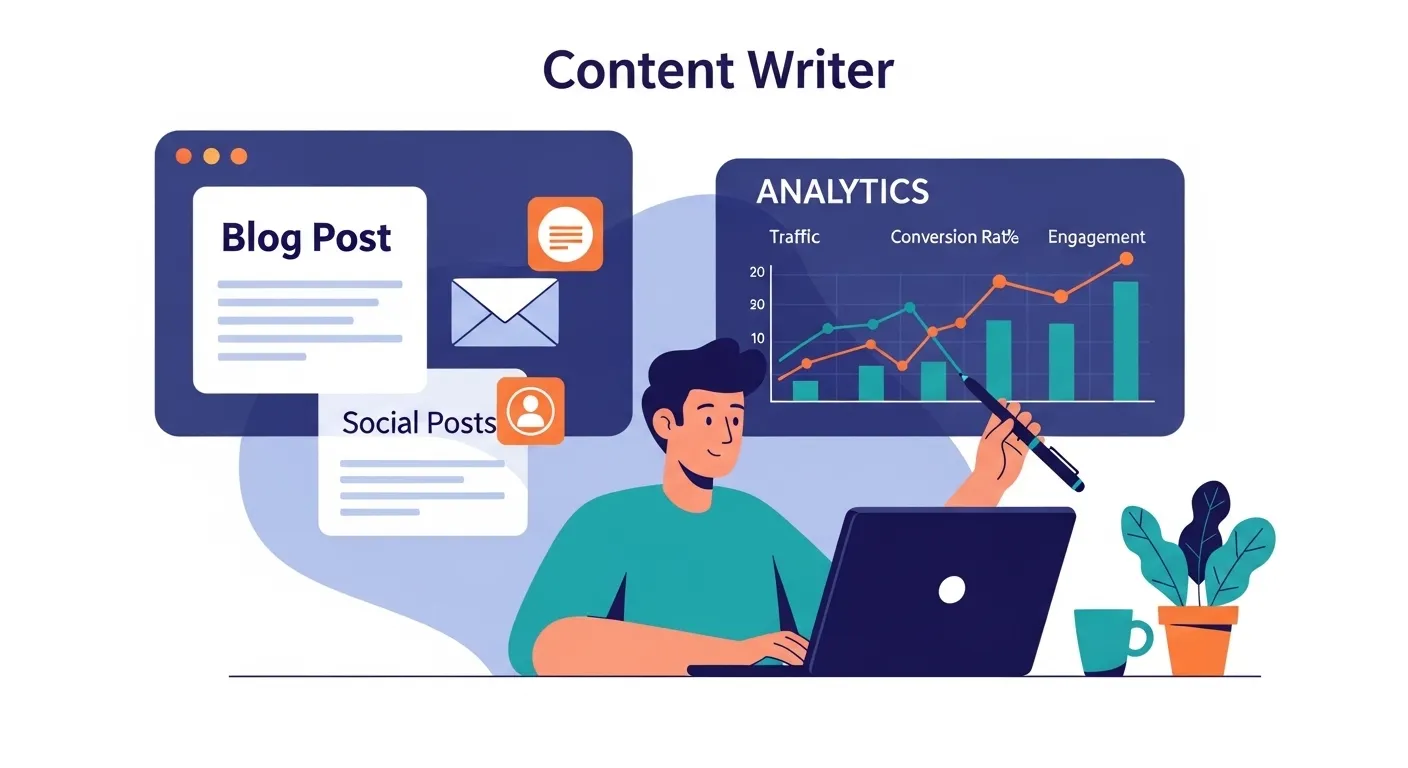
Hiring managers want proof that your work drives measurable results, not just that you can write clean sentences. They scan your resume for signals like organic traffic growth, conversion lifts, engagement gains, and email or ad performance, often before they ever look at your portfolio.
If your bullets only say "wrote blog posts" or "created social content," you sound interchangeable. When you show how those assets changed behavior, you start to look like a marketer who happens to write—not a writer hoping someone cares.
Common writing tasks → real metrics
You don't need perfect analytics for every piece, but you almost always have something you can quantify. Think in terms of traffic, engagement, conversions, and efficiency.
Here's how typical content work can map to numbers:
| Type of Work | Examples of Metrics You Can Use |
|---|---|
| Blog & SEO content | Organic traffic growth, time on page, bounce rate, ranking improvements |
| Email & newsletters | Open rate, click‑through rate, unsubscribe rate, revenue per send |
| Landing pages & funnels | Conversion rate, form fills, demo sign‑ups, cost per lead |
| Social content | Engagement rate, saves/shares, follower growth during a campaign |
| Copy for ads | CTR, CPC changes, ROAS, A/B test winner lifts |
| Documentation & UX copy | Task success rate, support tickets reduced, NPS/CSAT movement |
Pick the 1–2 clearest metrics for each role or project and build your bullets around those.
Traffic growth, click-through rate, lead volume, ranking improvements, time on page, or efficiency gains can all work.
A grounded estimate is still stronger than a vague bullet.
Rewrite your bullets: from tasks to outcomes
A simple structure that works well is: Action + Project + Result. Instead of listing what you were responsible for, you show what changed because you did it.
Before → after examples
-
Before: "Wrote blog posts for company website."
After: "Planned and wrote 3–4 SEO blog posts per month that grew organic sessions by 38% in six months for the careers section." -
Before: "Responsible for email newsletter copy."
After: "Revamped weekly newsletter subject lines and body copy, increasing average open rates from 23% to 31% and click‑throughs by 22%." -
Before: "Wrote product landing pages."
After: "Collaborated with product and design to rewrite two key landing pages, lifting free‑trial conversion from 4.2% to 6.1% (45% relative increase)."
Even if you only know ballpark ranges or relative improvements, a credible estimate beats a vague claim every time—as long as you could explain how you got it if asked.
More bullet upgrades by content type
| Weak bullet | Stronger bullet |
|---|---|
| Created social posts for campaigns | Wrote campaign social content that increased saves and shares during a product launch period |
| Helped with SEO content | Produced SEO content that improved organic sessions and supported ranking gains for target pages |
| Wrote email copy | Reworked email copy and subject lines to improve open rate and click-through performance |
| Drafted help center articles | Published support content that reduced repeat questions and made task completion clearer for users |
They still describe writing work, but they anchor it to business outcomes.
That is what makes a content writer sound strategic instead of generic.
A simple layout that sells your impact
Content writer resume templates for the next few years usually follow a straightforward structure that's friendly to both hiring managers and ATS.
Top of the page:
- Headline: "Content Writer" or "Content & SEO Writer" (or "B2B SaaS Content Writer" if you're niched).
- Summary (3–4 lines): who you write for, formats you handle, and 2–3 headline results (for example, "grew organic traffic by 40%" or "lifted email CTR by 25%").
Experience section:
- List roles in reverse order, 3–6 bullets each.
- Each bullet should highlight a format (blog, email, landing page, white paper) and a result (traffic, leads, revenue, engagement).
Skills & tools:
- Group skills that often matter for content roles:
- Strategy: content calendars, audience research, funnel mapping.
- SEO & analytics: keyword research, on‑page SEO, Google Search Console, analytics tools.
- Tools: CMS (WordPress, Webflow), email platforms, A/B testing tools.
And always include a clear, visible portfolio link, since content hiring managers treat it as almost as important as the resume itself.
Sample resume: content writer
Content writer with 5+ years of experience creating SEO articles, landing pages, email campaigns, and product-focused content for growth teams. Known for improving organic traffic, increasing email engagement, and writing conversion-focused copy tied to measurable results.
- Planned and wrote 3–4 SEO blog posts per month that grew organic sessions by 38% in six months
- Reworked weekly email newsletter copy, increasing average open rates from 23% to 31% and click-throughs by 22%
- Collaborated with product and design to rewrite landing pages, improving free-trial conversion from 4.2% to 6.1%
- Built content briefs and editorial plans aligned to audience intent, campaign goals, and keyword opportunities
- Wrote blog, social, and website copy for B2B campaigns across multiple client accounts
- Supported content refresh projects that improved page clarity, engagement, and search visibility
- Partnered with SEO and marketing teams to align content production with campaign priorities
Content Writing, SEO Copywriting, Content Strategy, Editorial Calendars, Keyword Research, On-Page SEO, Email Marketing, Landing Pages, Google Search Console, Google Analytics, WordPress, Webflow
- Clear headline tied to the target role
- Summary with formats and measurable impact
- Reverse-chronological experience
- Bullets that pair content type with outcomes
- Plain-text skills and a visible portfolio link
Keywords and ATS: don't forget the machines
For content and copy roles, ATS filters are often tuned around a handful of skills and channels. Common keywords include "SEO copywriting," "content strategy," "editorial calendar," "email marketing," "landing pages," "audience engagement," and the names of key tools.
The safest approach is to pull the most important phrases from the job description and weave them naturally into your summary, skills, and bullets—especially around the results you're already quantifying.
When your resume reads like this—specific formats, clear audiences, and concrete numbers—you're no longer just another "passionate storyteller." You're someone whose words can move a graph, which is exactly the kind of writer teams are trying to hire.
Skills section: generic vs targeted
| Generic skills list | Stronger targeted skills list |
|---|---|
| Writing, editing, communication, creativity | SEO copywriting, content strategy, editorial calendar, email marketing, landing pages, Google Search Console |
| CMS, analytics, social | WordPress, Webflow, Google Analytics, keyword research, audience engagement, A/B testing |
| Content creation | Blog writing, newsletter copy, conversion copy, product content |
A strong portfolio helps, but your resume still needs plain-text proof.
ATS systems do not score the quality of your portfolio link—they score the words and outcomes written on the resume itself.
FAQ
What metrics should content writers include on a resume?
Use metrics tied to content performance, such as organic traffic growth, open rate, click-through rate, conversion rate, leads, ranking improvements, engagement, or efficiency gains. Pick the clearest 1–2 metrics for each role or project.
How do I turn a writing task into a stronger resume bullet?
Use a simple formula: action + project + result. Instead of saying you wrote content, show what kind of content it was, who it was for, and what measurable outcome it produced.
Do content writer resumes need a portfolio link?
Yes. A visible portfolio link is important because hiring managers often want proof of your writing quality alongside your resume. But the resume still needs measurable outcomes written in plain text.
What keywords help a content writer resume pass ATS?
Common keywords include SEO copywriting, content strategy, editorial calendar, email marketing, landing pages, audience engagement, and the names of relevant tools. Use them naturally inside your summary, skills, and results-focused bullets.
What if I do not have exact numbers for every piece of content?
That is normal. Use the clearest credible metric or estimate you can defend, such as a traffic increase, engagement lift, conversion improvement, or relative change over time.