UX/UI Designer Resume 2026: How to Show Your Process, Not Just Pretty Screens
What hiring managers want to see in 2026
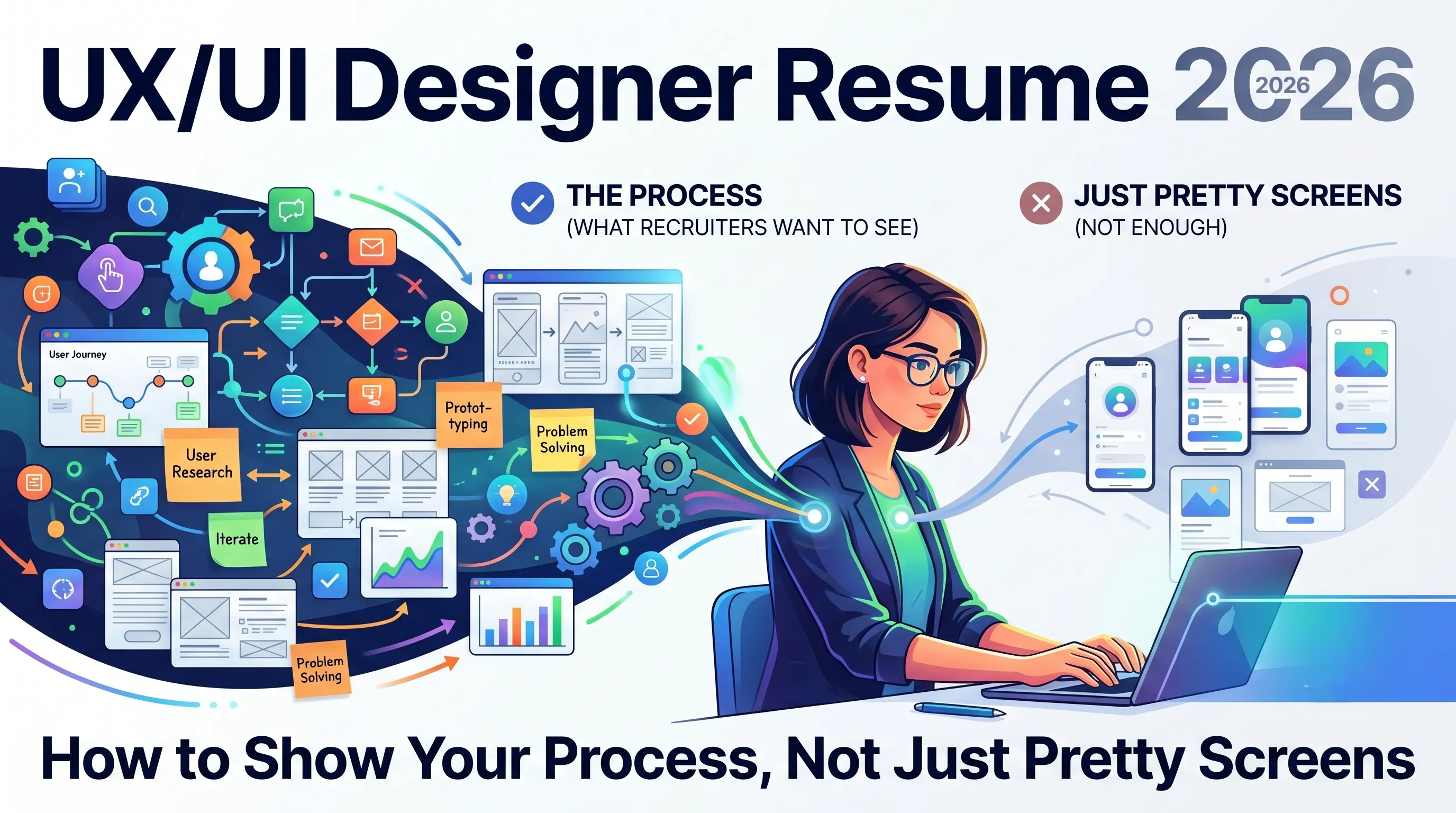
Recent UX resume guides are blunt: strong resumes connect research and decisions to shipped improvements and metrics. Managers know Dribbble is full of beautiful but context‑free UI; they are looking for designers who can define a problem, run just enough research, collaborate with engineering, and ship something measurably better.
That means your resume has to answer three questions fast:
- What kinds of problems have you worked on?
- What process did you use (in the real world, not just the textbook diagram)?
- What changed for users or the business because of your work?
Hiring managers are not just scanning for polished screens or tool names.
They want evidence of problem-solving, process, collaboration, and measurable product impact.
What hiring managers are screening for
UX/UI hiring teams want resumes that read like condensed case studies. They are looking for proof that you can identify a problem, choose methods that fit the situation, work with product and engineering, and ship something better for users and the business.
Beautiful UI vs product-impact UX
| Resume style | What it signals | Why it matters |
|---|---|---|
| Tool-first, screen-first bullets | Visual execution only | Feels shallow without context |
| Problem → process → outcome bullets | End-to-end product thinking | Shows how you work in real teams |
| Generic mention of research | Buzzword familiarity | Too vague to trust |
| Specific methods tied to outcomes | Evidence-based design practice | Makes your thinking visible quickly |
Strong visuals help, but they are not enough.
Hiring teams want to know what problem you solved, how you made decisions, and what changed after the work shipped.
Structure the resume around problems and outcomes
A lot of UX/UI resumes still lead with tools and deliverables—"Figma, Sketch, wireframes, prototypes"—and bury the actual impact. Updated 2026 guidance flips that: start with problems and outcomes, then show the methods you used.
Example experience bullet (weak vs strong)
- Weak: "Designed new dashboard screens for analytics product."
- Strong: "Redesigned analytics dashboard after contextual interviews and usability tests, increasing task success from 62% to 84% and cutting average completion time by 30%."
The strong version shows: research, design, testing, and measurable change—all in one line.
More bullet comparisons
| Weak bullet | Stronger bullet |
|---|---|
| Improved checkout flow | Redesigned checkout after interview and usability findings, reducing friction and improving completion rate |
| Worked on navigation redesign | Reworked IA and navigation labels after journey mapping, reducing confusion during core tasks |
| Created design system components | Built reusable components with engineering that improved consistency and sped up handoff |
| Designed onboarding screens | Iterated onboarding flow based on user feedback until completion targets were met |
It shows the problem, the method, and the result.
That is exactly what makes a UX bullet feel more like product work and less like a design task list.
Make your process visible in a few words
You do not need a full case study in the resume, but you do need process verbs—so reviewers can see how you think before they open your portfolio.
Sprinkle specific methods into your bullets, tied to outcomes:
- "Ran 8 remote interviews and a survey (n=120) to prioritize checkout pain points before redesign."
- "Mapped current user journey and redesigned IA, reducing navigation‑related support tickets by 18%."
- "Set UX success metrics with PM (completion rate and CES) and iterated flows until targets were hit."
UX resume articles consistently say this is what separates "I push pixels" from "I run a UX process that moves product metrics."
Process words that add signal fast
| Generic wording | Higher-signal wording |
|---|---|
| Researched users | Ran remote interviews, usability tests, or surveys |
| Improved flow | Iterated the flow against completion-rate targets |
| Worked with team | Partnered with PM and engineering on prioritization and handoff |
| Made wireframes | Mapped journey, redesigned IA, prototyped solutions, validated changes |
Verbs like ran, mapped, prioritized, validated, iterated, and partnered make your thinking easier to see than generic terms like worked on or helped with.
Use skills sections to show breadth, not buzzwords
Skills lists still matter for ATS and quick scans, but they should be organized and grounded in your actual work. Updated UX resume guidelines recommend grouping skills by type—tools, research methods, interaction/IA—so hiring managers can quickly match them to the role.
Example grouping:
- Research: user interviews, usability testing, surveys, heuristic reviews
- Design: interaction design, wireframing, prototyping, design systems, accessibility
- Tools: Figma, FigJam, Miro, Jira, Analytics (GA / Mixpanel)
Then your bullets do the real work of proving you've actually used those skills on real projects.
Skills section: weak vs useful
| Weak skills list | Stronger grouped skills list |
|---|---|
| Figma, UX, UI, prototyping, research | Research: user interviews, usability testing, surveys, heuristic reviews |
| Design, wireframes, teamwork, empathy | Design: interaction design, wireframing, prototyping, design systems, accessibility |
| Tools and methods mixed randomly | Tools: Figma, FigJam, Miro, Jira, Analytics (GA / Mixpanel) |
The skills block should help reviewers scan your breadth.
Your experience bullets still need to prove those skills were used on real product work.
Tie your resume to your portfolio (and case studies)
Hiring managers repeatedly say the portfolio is still "king," but the resume decides whether they ever see it. Your job is to make the connection effortless:
- Put a clean, clickable portfolio link right at the top, not buried.
- Under each major role, reference 1–2 case studies by name:
- "See case study: 'Checkout redesign – +23% conversion' at mysite.com/work/checkout."
Current UX/portfolio advice is clear: aim for a small number of strong case studies that show end‑to‑end process (problem → research → design decisions → outcomes), and let your resume act as the index to those stories.
If you can make that process visible in a handful of sharp bullets and links, your 2026 UX/UI resume will do what it's supposed to: get the right people to click through and spend real time with your work.
Resume and portfolio: how they should work together
| Resume | Portfolio |
|---|---|
| Gives a fast scan of problems, methods, and outcomes | Shows the full story, visuals, trade-offs, and deeper reasoning |
| Helps ATS and hiring managers shortlist you | Helps interviewers evaluate how you think |
| Should mention case studies clearly | Should justify the claims made on the resume |
Sample resume: UX/UI designer
UX/UI Designer focused on turning research into shipped product improvements. Experienced in user interviews, usability testing, IA, and prototyping, with a track record of improving task success, reducing friction, and supporting clearer product decisions.
- Redesigned analytics dashboard after contextual interviews and usability tests, increasing task success from 62% to 84% and cutting average completion time by 30%
- Ran 8 remote interviews and a survey (n=120) to prioritize checkout pain points before redesign
- Mapped the current user journey and redesigned IA, reducing navigation-related support tickets by 18%
- Partnered with PM and engineering to define UX success metrics and iterate until targets were reached
- See case study: "Checkout redesign – reduced friction in key flow" at elenapark.design/work/checkout
- Designed onboarding flows and tested prototypes with users to improve completion and confidence in setup
- Built reusable design patterns with engineering to improve consistency across product surfaces
- Supported product teams with wireframes, interaction design, and handoff documentation
Research: user interviews, usability testing, surveys, heuristic reviews
Design: interaction design, wireframing, prototyping, information architecture, design systems, accessibility
Tools: Figma, FigJam, Miro, Jira, GA, Mixpanel
- Leads with problem-solving and shipped outcomes
- Makes process visible in a few words
- Groups skills by type instead of dumping buzzwords
- Links directly to a case study
- Shows collaboration with PM and engineering
FAQ
What do UX hiring managers want to see on a resume in 2026?
They want to see the problem you worked on, the process you used, and the measurable outcome. A strong UX/UI resume connects research and design decisions to shipped product improvements.
Should a UX resume focus more on tools or outcomes?
Outcomes should lead. Tools matter, but they are secondary to evidence that you used research, design, and collaboration to improve something for users or the business.
How much process should I show on a UX/UI resume?
Show just enough process to reveal how you think. A few method words—like interviews, usability testing, journey mapping, IA, prototyping, and iteration—are usually enough when tied to results.
Should I put case study links on my UX resume?
Yes. Put a clear portfolio link at the top, and reference major case studies under relevant roles when possible. The resume should make it easy for reviewers to click through.
What should a UX skills section include?
Group skills by category, such as research, design, and tools. That makes your breadth easier to scan and keeps the section useful for both ATS and hiring managers.