Cover Letter or Not in 2026? Recruiter-Backed Rules for When You Can Skip It
The cover-letter myth that wastes your time
For years, you have probably heard the rule: never apply without a cover letter.
In 2026, that advice is half true at best.
There are roles where a tailored letter meaningfully boosts your odds, and others where writing one is busywork that no one will read.
The real skill now is knowing the difference.
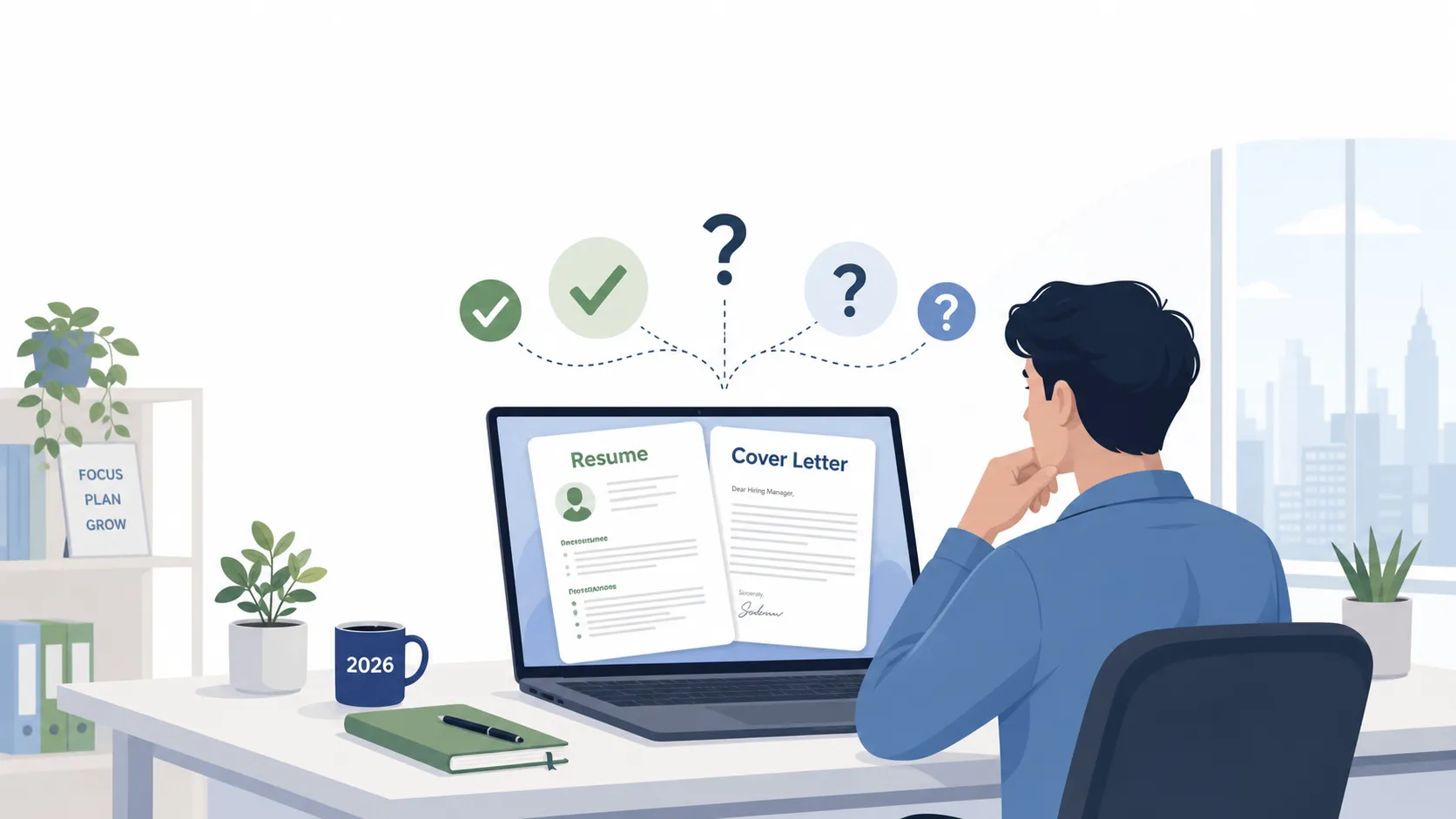
Do not ask "Do cover letters matter?".
Ask "Does a cover letter matter for this specific role, at this specific company, through this specific channel?".
This guide walks you through a simple decision process, concrete scenarios, and real examples so you know when to invest in a letter and when to safely skip it without hurting your chances.
Read the posting like a hiring manager, not a job seeker
Most people skim job ads for salary, location, and responsibilities.
If you want to use your time strategically, you need to read them like the person on the other side of the portal.
Your goal is to spot hidden signals about how much human attention each application will get.
Pay attention to three things:
- Application volume: mass-market job boards, "easy apply" buttons, and generic descriptions usually mean hundreds of applicants.
- Signal of care: roles that mention nuanced responsibilities, writing, stakeholders, or executive exposure are more likely to receive careful review.
- Instructions: language around "required", "strongly preferred", or "optional" is not decoration; it tells you how much structure the process has.
If a company cannot write a clear posting or contradicts itself, do not assume they have precise rules about cover letters.
Use your judgment instead of blindly following old job-search dogma.
Know the three cover-letter zones in 2026
Almost every application you submit falls into one of three zones.
Understanding these makes the decision far easier.
| Zone | What it looks like | Cover letter move |
|---|---|---|
| Required | The posting clearly asks for a cover letter or asks specific questions you must address | Always write one, tailored to the role |
| High impact | Professional role, human-reviewed, cover letter optional but process feels selective | Write one if you genuinely want the job |
| Low impact | High-volume, quick-apply, hourly or transactional roles, no place to upload a letter | Safely skip; invest time in your resume and applications instead |
The mistake most candidates make is treating everything like zone one or everything like zone three.
In reality, the best strategy is to spend your writing energy where a human is most likely to actually read it.
When a posting says "cover letter optional" for a professional role, it is often shorthand for "we will notice who cares enough to send one".
Skipping it there can quietly push you behind candidates with similar resumes.
Situations where you should almost never skip the cover letter
There are cases where a cover letter is still one of your sharpest tools.
Skipping it here is like deliberately playing with a handicap.
You should almost always write a tailored letter when:
- The posting explicitly says "cover letter required" or asks questions that clearly belong in a letter.
- The role is competitive and communication-heavy: consulting, product, marketing, policy, leadership, or client-facing positions.
- You are changing careers, returning after a long gap, or relocating and need to explain context.
- You are applying to a mid-sized or large company through their main career site for a role you really care about.
In these scenarios, the letter is your one chance to connect the dots in ways your resume cannot.
You can show judgment, motivation, and writing skill in a few short paragraphs—exactly what many hiring managers want to see before they make room in their calendars.
Imagine two candidates with similar resumes applying to a communications role.
One sends only a resume.
The other sends a tight, 300-word letter that clearly explains their interest, highlights one relevant project, and mirrors the tone of the company.
Even if both are qualified, the person who wrote the letter has already demonstrated the core skill the role requires: clear, audience-aware writing.
Situations where you can safely skip the cover letter
On the other side, there are scenarios where a cover letter is unlikely to change the outcome.
In these cases, writing one is not wrong—but it may not be the best use of limited time and energy.
You can usually skip the cover letter when:
- The application system literally has no way to attach or paste a letter.
- The job is a high-volume hourly role with hundreds of near-identical postings, like seasonal retail, warehouse, or basic customer support.
- You are using "one-click" or "easy apply" tools where the platform is optimized for speed, not nuance.
- A recruiter or hiring manager has clearly told you they only want a resume for now.
The key is not to be lazy; it is to be intentional.
If you skip the letter, that time should go into tailoring your resume, refining your portfolio, or sending warm outreach messages to people inside your target companies.
Do not skip the cover letter because "no one reads them" or because friends told you they never write one.
Skip it only when the role, process, and context make it a low-leverage move.
Use a simple decision tree before every application
You do not need a spreadsheet of rules.
A 30-second decision tree is enough.
Run through these questions before you click apply.
- Does the posting clearly require a cover letter or ask you to explain something (motivation, career change, relocation)?
If yes, write one. - Is the role professional or strategic, and do you care strongly about it?
If yes, treat that as a high-impact zone and write one, even if optional. - Is the application high-volume, low-skill, or missing any field for a letter?
If yes, focus on your resume and speed instead. - Are you being referred by someone who will personally vouch for you?
Often a short, thoughtful email can replace a formal letter.
- I confirmed there is no required cover-letter field.
- The role is high-volume or low-discretion.
- I tailored my resume to the posting.
- I used my saved time to apply to more high-fit roles or send targeted outreach.
How to replace a cover letter when you do not send one
Skipping a full letter does not mean sending a silent, context-free application.
You still want to show intention and make it easy to see why you are a match.
Three lightweight alternatives that work well in 2026:
- A short "note to recruiter" or "summary" field in the application portal.
- A customized resume summary that mirrors the language of the posting.
- A brief email or direct message to the recruiter or hiring manager when appropriate.
Here is an example of a short note that can stand in for a full cover letter in a quick-apply situation:
"I am a customer-support specialist with three years handling high-volume chat and email queues in SaaS.
I am especially drawn to this role because of your focus on first-contact resolution.
In my current role, I helped reduce repeat tickets by 18 percent through better macros and documentation.
I would love to bring that mindset to your team."
Thirty to sixty seconds of extra effort can place you well above the candidates who simply fire off a generic resume.
A side-by-side look at when to write and when to skip
Sometimes it is easier to see the pattern in concrete examples.
Use this table as a quick reference.
| Scenario | Role type | Application channel | Cover letter move |
|---|---|---|---|
| Analyst role at a mid-size tech company | Professional, writing and stakeholder-facing | Company career site, field for cover letter | Write a tailored letter |
| Seasonal retail associate | Hourly, high-volume | Mass job board with no cover-letter upload | Skip; focus on resume and availability |
| Marketing manager at a startup with 20 employees | Senior individual contributor, high impact | Direct email to founder or head of marketing | Write a concise, targeted letter or email |
| Warehouse worker, night shift | Operational, high-volume | Quick-apply via app, no additional text field | Skip; keep resume clear and consistent |
| Product manager role, obvious career change from teaching | Professional, strategic, big transition story | Company portal with optional letter | Write one; use it to explain the pivot |
You will notice the pattern: the more judgment, communication, and context the role involves, the more a cover letter can help.
Sample strong cover letter for 2026
To make this concrete, here is a compact cover letter that works for a modern, professional role.
Notice the tight length, specific hook, and clear proof.
Aim for three to four short paragraphs: hook, proof, fit, and close.
Dear Hiring Manager,
I am applying for the Senior Customer Success Manager role on your team.
Over the past six years, I have helped B2B SaaS customers adopt complex products, reduce churn, and grow their accounts in fast-changing environments.
In my current role at a mid-size SaaS company, I manage a portfolio of 40 enterprise customers across three regions.
By redesigning our onboarding playbook and introducing quarterly business reviews, I helped reduce logo churn from 9 percent to 5 percent year over year while increasing expansion revenue by 22 percent.
What excites me most about this role is your focus on partnering closely with product.
I have led multiple feedback loops between customers and product teams, including a recent initiative where we turned common support tickets into feature requests that led to a usability redesign.
Seeing those changes go live and immediately cut ticket volume was the highlight of my year.
I would welcome the chance to discuss how I can help your customer success team deepen relationships with key accounts and support your growth goals in 2026.
Sincerely,
Jordan Lee
Even if someone skims this letter, they will walk away with three key ideas: what role you want, what kinds of problems you solve, and one or two concrete results.
FAQ
Do recruiters still read cover letters in 2026?
Many do, but not for every single application.
They are more likely to read your letter when the role is professional, the process is selective, or the posting explicitly asks for one; they are less likely to read it for high-volume hourly roles.
When is it safe to skip a cover letter?
It is usually safe to skip when there is no way to upload one, when the job is clearly high-volume and transactional, or when a recruiter has told you they only need a resume.
In those cases, your energy is better spent tailoring your resume or applying to more high-fit roles.
If a cover letter is optional, should I still send one?
If the role is professional and you genuinely want it, sending a concise, tailored letter is almost always worth it.
"Optional" often means "we will notice who made the extra effort," especially for roles involving writing, communication, or leadership.
Can a bad cover letter hurt my chances?
Yes.
A generic, unfocused, or error-filled cover letter can easily hurt you more than no letter at all because it raises doubts about your communication skills and attention to detail.
If you cannot tailor it properly, it is often better to skip it.
How long should a cover letter be in 2026?
Aim for roughly 250 to 400 words.
That is enough space to show motivation, share one or two concrete achievements, and connect your experience to the role without overwhelming a busy reader.