First Tech Job in 2026: Resume Template That Works for Self‑Taught Developers
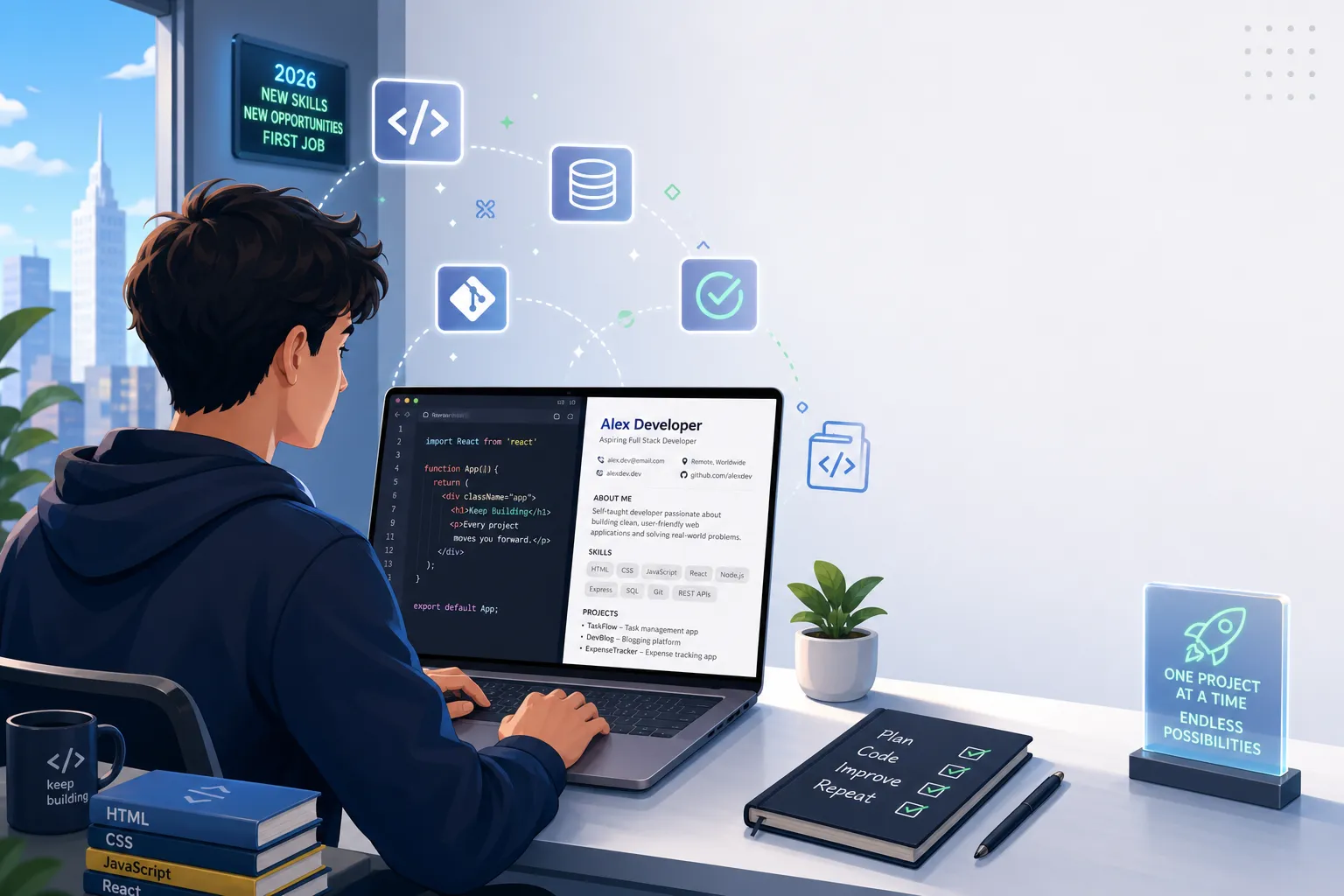
Your resume has to prove you can ship, not that you went to school
If you are self-taught and trying to land your first job in tech, it is easy to feel years behind people with computer science degrees.
The good news: hiring managers care far more about what you can build than whether you learned it in a lecture hall.
Your resume’s job is simple and unforgiving — in seconds, it has to prove you can ship working software with a modern stack.
Degrees signal potential.
Real projects, clean code, and a focused resume signal proof.
As a self-taught developer, your edge is that you already know how to learn on your own and ship without hand-holding.
This guide walks you through a 2026-ready resume layout, section by section, built specifically for self-taught developers.
You will also see a full template you can adapt, plus examples and checklists along the way.
Pick a clear developer identity for your headline
The weakest self-taught resumes open with “Aspiring developer” or “Learning to code.”
That language makes you sound like a student forever stuck in preparation mode.
Your headline should instead claim a lane and make it obvious which kind of problems you want to be hired to solve.
Good headline patterns:
- Front-End Developer
- Backend Developer
- Full-Stack Developer
- Mobile App Developer
- Junior Data Engineer
If you truly enjoy multiple areas, pick the one that most closely matches the job description you are sending the resume to.
You can always tweak your headline per application.
If the posting says “Junior Backend Engineer,” mirror that structure in your headline.
It helps both human reviewers and applicant tracking systems connect you to the role.
Choose a resume structure that fits a self-taught profile
For a self-taught developer with little or no formal experience, a standard corporate layout does not work.
You need to push your proof — projects and skills — higher than education or unrelated jobs.
A simple structure that works extremely well in 2026:
- Summary
- Projects
- Technical Skills
- Experience (relevant and transferable)
- Education and Learning
- Extras (open-source, hackathons, speaking, blogging)
Here is how the priorities shift compared to a traditional graduate resume:
| Section | Traditional CS grad priority | Self-taught developer priority |
|---|---|---|
| Education | Very high | Medium |
| Projects | Medium | Very high |
| Skills | Medium | High |
| Experience | High if tech, low if unrelated | Medium, focused on transferability |
| Extras (portfolio, OSS) | Nice-to-have | High impact |
Aim for a single page unless you have real professional development experience.
Make every line earn its place by proving a skill, responsibility, or result.
Write a summary that replaces the missing degree
Your summary is not a biography.
It is a tight elevator pitch that answers three questions quickly: who you are, what you can build, and why you are a safe bet for this role.
Aim for three short lines:
- Line 1: Your role and focus.
- Line 2: Two or three concrete skills or areas of strength.
- Line 3: One sentence about what you are looking for and how you want to contribute.
"Self-taught full-stack developer focused on building clean, maintainable web applications with React and Node.
Built and deployed several real-world projects, including a habit-tracking app and a small business inventory tool.
Now looking for a junior engineering role where I can ship features, learn from experienced teammates, and improve system reliability."
Avoid apologetic language like “junior but passionate,” “no experience yet,” or “hoping to get my first opportunity.”
Your projects and skills already make that context clear.
Make Projects the star of the show
If you have no prior dev job, projects are your primary evidence.
They should sit directly under your summary and be the most detailed section on the page.
Treat each project like a mini job:
- Project name and type (web app, API, CLI tool, mobile app).
- Tech stack.
- One sentence of context (who it is for, what problem it solves).
- Two or three bullets that show how it works and what made it hard.
A useful pattern for your bullets:
Action + what you built + why it mattered + interesting technical detail.
Here is a quick before-and-after comparison:
| Weak project bullet | Strong project bullet |
|---|---|
| "Built a to-do list app in React." | "Built a responsive task manager in React with drag-and-drop reordering and local storage syncing so users keep their lists across sessions." |
| "Created a weather app." | "Developed a weather dashboard that calls a public API, caches responses, and displays hourly forecasts with custom hooks for data fetching and error handling." |
| "Made a portfolio site." | "Designed and implemented a single-page portfolio site with a custom CSS grid layout, lazy-loaded images, and a simple contact form backed by a serverless function." |
Two or three polished projects you can explain in depth are far more persuasive than ten tutorial clones.
Choose work that uses the same stack the job posting cares about.
Build a skills section that actually signals level
Many self-taught resumes either list every tool ever touched or list almost nothing.
Neither helps a hiring manager understand where you can contribute on day one.
A better approach is to group skills and silently hint at your comfort level.
For example:
- Languages: JavaScript, TypeScript, Python
- Front-end: React, Next.js, HTML, CSS, Tailwind
- Back-end: Node.js, Express, REST APIs, PostgreSQL
- Tools and practices: Git, GitHub, Docker (basics), unit testing, debugging
You can also create soft tiers by ordering skills from strongest to weakest within each group.
If you are genuinely comfortable building features with React but only experimented with Vue, put React first.
Listing every tool you have watched a tutorial on makes you look scattered.
It is better to show a smaller, coherent stack that matches the role.
Reframe non-tech work as proof you can function on a team
Most self-taught developers have prior experience in other fields.
The instinct is either to remove those jobs entirely or to leave them as long lists of unrelated tasks.
Both moves waste a chance to prove you can operate in a professional environment.
You cannot turn a retail job into a dev job.
But you can show signals that matter to engineering teams: reliability, communication, ownership, dealing with customers, and solving operational problems.
Here is how to translate a non-tech job into something relevant:
| Original bullet | Reframed for tech hiring |
|---|---|
| "Worked the cash register and stocked shelves." | "Handled high-volume customer interactions during peak hours while keeping error rates low and transactions accurate." |
| "Answered customer calls." | "Resolved customer issues over phone and chat, escalating complex cases with clear notes so teammates could pick up quickly." |
| "Trained new staff." | "Onboarded new team members by documenting procedures and walking them through key systems, reducing training time." |
Your non-tech Experience section does not need to be long.
Two or three strong bullets per job are enough to show you can show up, communicate, and own responsibilities.
Use Education and Learning to legitimize your path
Being self-taught does not mean being unstructured.
Use your Education and Learning section to show that you followed a deliberate path rather than a random collection of tutorials.
Include:
- Any formal degrees, even if not in computer science.
- Bootcamps or intensive programs you completed.
- Well-known online curricula or certificates.
- A very short list of standout courses if they map directly to the role.
Good examples of learning entries:
- "Completed an intensive full-stack JavaScript program focused on React, Node, and relational databases."
- "Followed a structured self-study path in algorithms, data structures, and web development using well-known open learning resources."
- "Built capstone projects as part of an advanced front-end course, including a complete design-to-deploy workflow."
For self-taught candidates, education supports the story — it should not lead it.
Your projects and skills section do the heavy lifting.
See a complete 2026 resume template for self-taught developers
Below is a full one-page resume example using the structure from this article.
Use it as a template to adapt, not something to copy line by line.
Swap in your own projects, stack, and outcomes.
Keep the sections and order, but let your own projects and stack drive the details.
Self-taught full-stack developer focused on building practical web applications with React, Node, and relational databases.
Comfortable owning features end to end, from UI to API.
Looking for a junior engineering role where I can ship production code, learn from experienced teammates, and contribute to a modern product.
- Built a responsive single-page app that lets users create daily habits, track streaks, and view progress over time.
- Designed and implemented a REST API with JWT-based authentication, input validation, and error handling.
- Added a simple analytics view that aggregates habit completion rates and highlights at-risk habits.
- Developed a dashboard that lets users track watchlists and simulate simple portfolios with real-time price updates.
- Implemented search and filtering, pagination, and a clean card-based layout optimized for mobile.
- Used serverless functions for scheduled updates and basic caching to reduce API calls.
- Created a lightweight ticketing system for a small local business to log, assign, and resolve support requests.
- Implemented role-based views so staff could see only their assigned tickets, with status filters and basic reporting.
- Learned how to structure a small MVC-style app and keep the codebase readable for non-expert collaborators.
Languages: JavaScript, TypeScript, Python
Front-end: React, Next.js, HTML, CSS, Tailwind
Back-end: Node.js, Express, REST APIs, PostgreSQL, SQLite
Tools & practices: Git, GitHub, unit testing, debugging, command line, basic Docker
- Managed a high volume of phone and chat inquiries, maintaining accurate records in internal tools.
- Noticed recurring issues in delivery status questions and suggested changes to the FAQ, reducing repeat contacts.
- Collaborated with a small operations team to smooth communication between drivers and customers.
- Handled busy morning rushes while keeping orders accurate and service friendly.
- Trained new staff on point-of-sale workflows and opening/closing procedures.
Self-directed full-stack web development path, 2022 – Present
- Completed structured learning in JavaScript, React, Node, and SQL.
- Studied core computer science topics such as data structures, algorithms, and HTTP fundamentals.
BA, Psychology, State University
Personal portfolio with project write-ups and code samples available upon request.
Regularly participate in online coding challenges and small group study sessions.
Common mistakes self-taught developers make on resumes
Knowing what to avoid saves you as much time as knowing what to include.
Here are patterns hiring managers quietly use to filter out self-taught candidates.
- Overloading the resume with every language and tool ever touched.
- Hiding projects at the bottom instead of featuring them.
- Using vague bullets like “worked on many projects” instead of concrete examples.
- Leaving unexplained gaps where it looks like nothing was happening.
- Linking to unfinished or broken portfolio projects.
Avoid phrases like "even though I am self-taught" or "despite not having a degree".
Show your work, tell a clear story, and let your projects and persistence speak for you.
FAQ
How many projects should a self-taught developer list on a 2026 resume?
Two to four well-documented projects are usually enough.
Each project should have a clear purpose, a defined tech stack, and at least two strong bullets that explain what you built and why it matters.
Where should projects go on a self-taught developer resume?
Place your Projects section near the top of the resume, directly under your summary.
For self-taught candidates without previous dev jobs, projects are the main evidence of skill and should not be buried.
Should self-taught developers include non-tech work experience?
Yes, but selectively.
Keep only the roles where you can show reliability, ownership, teamwork, or problem solving, and write the bullets in a way that highlights those traits instead of listing generic duties.
How important is a portfolio or code hosting profile in 2026?
Very important.
Your resume should point to a small number of polished, working projects with readable code and simple explanations so that reviewers can quickly verify what you can do.
Can a self-taught developer resume compete with computer science graduates?
Yes.
When your resume highlights focused projects, a coherent tech stack, ongoing learning, and evidence that you can work in a professional environment, you can absolutely compete for junior roles alongside traditional graduates.