Career Change Resume Examples for 2026: Reframe Your Experience and Get Hired

Career change resumes are not about starting over
Changing careers can make a strong professional feel oddly inexperienced. You may have years of results, leadership, problem-solving, and industry knowledge, yet the job description in front of you uses a different vocabulary.
That is the real challenge of a career change resume: not hiding your past, but translating it.
A successful resume for a career pivot helps a hiring manager answer three questions quickly:
- Why does this move make sense?
- Which parts of your experience transfer directly?
- What evidence shows you can succeed in the new role?
This guide includes career change resume examples for 2026, a step-by-step writing method, transferable skills tables, before-and-after bullet rewrites, and complete resume samples for several common career transitions.
Your resume should not ask employers to imagine your potential from scratch. It should connect your existing proof to the problems the new role needs solved.
What is different about a career change resume in 2026?
A traditional resume usually tells a straight-line story: similar roles, increasing responsibility, and deeper expertise in one field. A career change resume has a different job. It must create a credible bridge between where you have been and where you are going.
That means your resume needs to do more than list employment history. It should:
- Lead with a target-focused professional summary.
- Reframe previous achievements in the language of the new field.
- Prioritize transferable skills over industry-specific duties.
- Show recent learning, projects, certifications, or practical exposure.
- Reduce attention on irrelevant experience without creating unexplained gaps.
- Make the intended career direction obvious within the first third of the page.
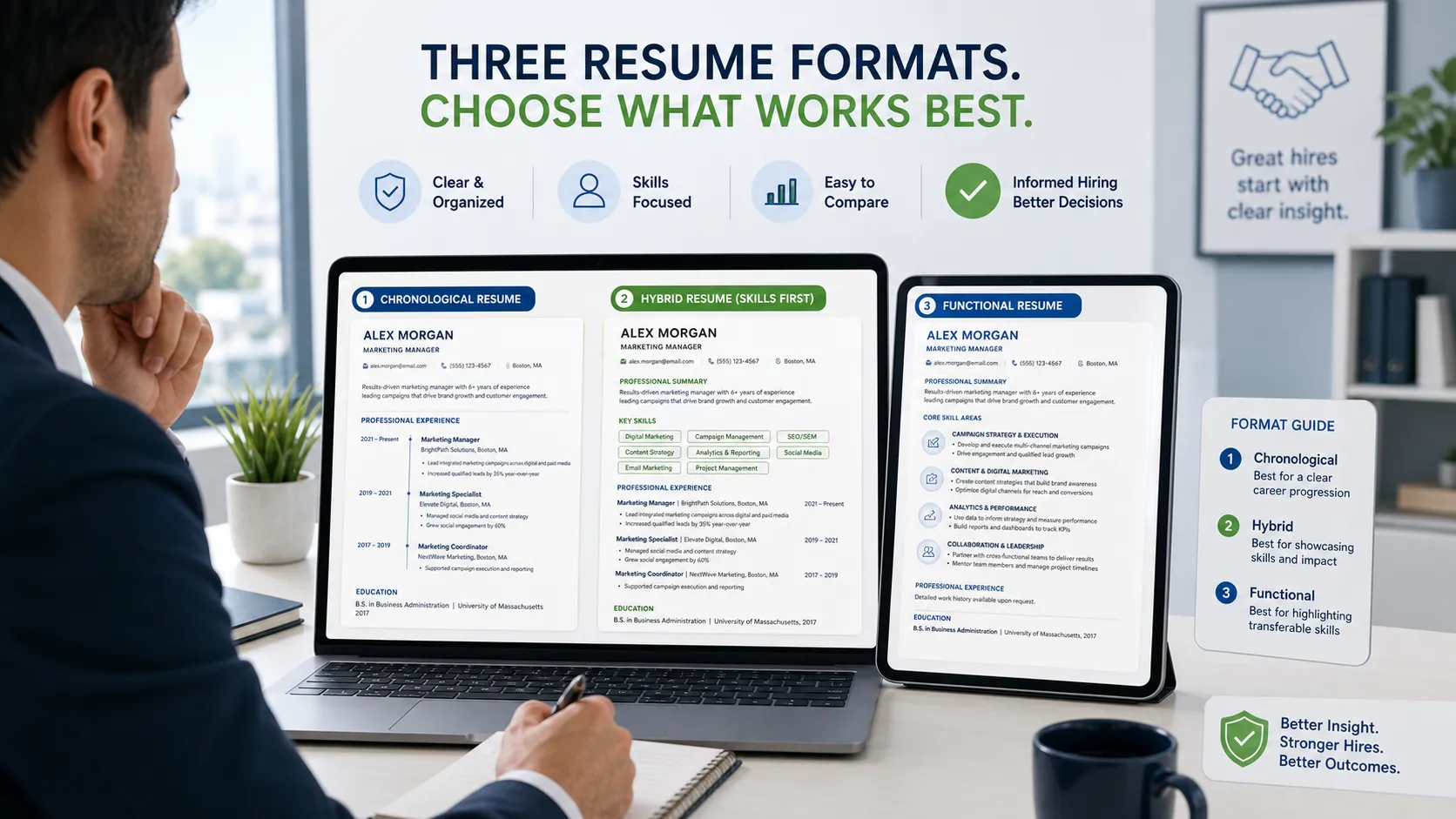
The strongest career change resumes are usually hybrid resumes. They keep a familiar chronological work history, but add a focused summary, a relevant skills section, selected achievements, and sometimes a projects section before the full experience timeline.
| Resume approach | Best for | Main risk |
|---|---|---|
| Chronological | A small or closely related career shift | Old job titles may dominate the story |
| Functional | Candidates with limited formal experience in the target field | Can look vague or make employers wonder what is being hidden |
| Hybrid | Most career changers with valuable transferable experience | Requires careful editing to avoid repetition |
| Project-led | Career changers entering technical, creative, analytical, or portfolio-based roles | Projects must show real depth, not tutorial-level work |
For most career changers, a hybrid format is the safest choice. It gives recruiters a clear timeline while allowing relevant skills, projects, and achievements to appear before less useful details.
The best title for a career change resume
Do not place a vague label such as “Career Changer” under your name. Use a headline that points toward the role you want and supports it with a credible strength.
Good headline formulas include:
- Target Role | Transferable Strength | Relevant Specialty
- Experienced [Current Profession] Transitioning to [Target Field]
- [Target Role] Candidate | [Relevant Skill] | [Relevant Skill]
- Operations Leader Moving into Project Management
Examples:
| Career transition | Strong resume headline |
|---|---|
| Teacher to instructional designer | Instructional Design Candidate |
| Retail manager to customer success | Customer Success Professional |
| Accountant to data analyst | Data Analyst Candidate |
| Nurse to healthcare administration | Healthcare Operations Professional |
| Military to logistics | Logistics and Operations Specialist |
Your headline should be ambitious but accurate. “Software Engineer” may be too strong if you have completed only one introductory course. “Junior Software Developer | Python | API Projects” is clearer and more believable.
Choose one target role
A career change resume becomes weak when it tries to support several unrelated directions at once. “Open to marketing, operations, HR, project management, and customer success” may feel flexible, but it creates a fuzzy value proposition.
Choose one primary target for each resume version.
Start by collecting several job descriptions for similar roles and identify recurring requirements. Look for repeated responsibilities, tools, outcomes, and business problems. Your goal is not to copy wording mechanically. It is to understand how the new profession describes valuable work.
Create four lists:
- Responsibilities you have already handled.
- Skills you have used in a different context.
- Requirements you are currently developing.
- Gaps that may need training, projects, or a more junior entry point.
A general resume usually underperforms during a career change because the employer must work too hard to understand the match. Build a focused version for each distinct target role.
Build a transferable skills map
Transferable skills are not generic personality traits. “Hardworking,” “motivated,” and “good communicator” are claims. Transferable skills are capabilities you can demonstrate through outcomes.
Use a translation table to connect your previous work to the target role.
| What you did before | Transferable capability | How it may appear in the new field |
|---|---|---|
| Managed a classroom of 30 students | Facilitation, planning, stakeholder communication | Led structured training sessions and managed varied learner needs |
| Ran a busy retail store | Operations, coaching, performance management | Coordinated daily service delivery and improved team performance |
| Prepared monthly financial reports | Analysis, data quality, business communication | Built recurring reports and explained trends to decision-makers |
| Coordinated patient appointments | Scheduling, process control, customer care | Managed high-volume workflows while maintaining service standards |
| Planned military movements | Logistics, risk management, execution | Coordinated time-sensitive operations across people, equipment, and locations |
| Organized community events | Vendor coordination, budgeting, promotion | Delivered multi-stakeholder projects within budget and schedule |
A useful test is to remove the old industry from the sentence. Does the achievement still sound relevant?
For example:
- Industry-bound: “Managed year-end merchandising resets across three departments.”
- Transferable: “Coordinated a time-sensitive rollout across three teams, maintaining schedule accuracy and resolving resource conflicts.”
The second version keeps the operational value while removing unnecessary retail language.
Write a bridge summary
Your summary is where you explain the career move without sounding apologetic. It should not be a personal essay, and it should not begin with “I am seeking a career change.”
A strong bridge summary usually contains:
- Your professional identity or years of relevant experience.
- Two or three transferable strengths.
- One or two concrete outcomes.
- Evidence of preparation for the new field.
- The target role.
Use this structure:
[Professional identity] with experience in [relevant responsibilities]. Known for [strengths] and [result]. Recently developed [target-field capability] through [course, project, certification, or practical work]. Ready to contribute as a [target role].
Experienced professional looking for a new challenge in a different industry. Hardworking, adaptable, and eager to learn. Seeking an opportunity where I can grow and use my people skills.
Retail operations manager with seven years of experience leading customer-facing teams, improving service processes, and resolving escalated client issues. Increased repeat-customer participation through structured follow-up and team coaching. Now transitioning into customer success after completing hands-on CRM and account-management projects.
The stronger version does not ask the employer to take a chance based on enthusiasm alone. It presents an understandable transition supported by evidence.
Rewrite experience around outcomes, not old job duties
Your old job title may not match the target role, but your achievements can still be highly relevant. The key is to change the emphasis.
A useful bullet formula is:
Action + transferable work + scope + result + business relevance
Compare these examples.
| Before | Career-change rewrite |
|---|---|
| Taught English classes to high school students | Designed and delivered structured learning programs for 120 learners, adapting materials based on performance data and individual needs |
| Responsible for opening and closing the store | Managed daily operating controls for a high-volume location, including staffing, cash procedures, incident response, and handover accuracy |
| Prepared weekly spreadsheet reports | Consolidated operational data into weekly dashboards that helped managers identify delays and prioritize corrective actions |
| Answered customer complaints | Resolved complex customer issues, identified recurring service failures, and coached team members on prevention |
| Scheduled nurses and appointments | Coordinated staffing and appointment schedules across multiple service lines while balancing urgency, availability, and patient needs |
Reframing is not exaggeration. You are allowed to describe the same work in language that makes its relevance easier to see, as long as the scope and results remain accurate.
Before-and-after bullet examples
Teacher to project coordinator
Before: Prepared lesson plans and taught daily classes.
After: Planned and delivered multiple concurrent learning programs, managed deadlines, coordinated resources, and adjusted delivery based on progress data.
Restaurant manager to operations specialist
Before: Managed shifts and made sure customers were happy.
After: Directed daily operations for a high-volume service team, balancing staffing, inventory, quality standards, and real-time issue resolution.
Administrative assistant to human resources coordinator
Before: Booked interviews and filed employee paperwork.
After: Coordinated candidate interviews, maintained confidential employee records, and improved document tracking for onboarding activities.
Add proof that the career change is already underway
Employers are more confident when your resume shows movement, not just intention. Evidence may come from:
- A relevant certification or structured course.
- A portfolio project.
- Volunteer work.
- Freelance assignments.
- Internal projects at your current employer.
- Professional association participation.
- Job shadowing or mentorship.
- A practical case study based on a realistic business problem.
A project section can be especially useful for technology, design, data, marketing, finance, writing, and project-management transitions.
Project entry example
Customer Churn Analysis Project | 2026
- Cleaned and analyzed a sample customer dataset using spreadsheets and SQL.
- Identified behavior patterns associated with account cancellation.
- Built a dashboard summarizing retention risks and recommended follow-up actions.
- Presented findings in a concise business report for a non-technical audience.
The project works because it demonstrates process, tools, and communication. “Completed an online SQL course” is useful, but “used SQL to answer a business question and explain the result” is stronger.
Do not fill the resume with certificates while leaving practical ability unproven. Training supports a career change; applied work makes it credible.
Organize the resume in the right order
For most career changers, the strongest section order is:
- Name and target headline.
- Contact details.
- Professional summary.
- Relevant skills.
- Selected achievements or projects.
- Professional experience.
- Education and certifications.
- Additional information, if useful.
This order lets the reader understand your direction before seeing job titles from the previous career.
When to place education higher
Move education or certification closer to the top when:
- The qualification is recent and directly related to the target role.
- The field has formal licensing or credential requirements.
- You have limited professional evidence in the new area.
- Your degree includes substantial projects relevant to the role.
Keep it lower when your professional achievements are more persuasive than the qualification.
Tailor keywords without forcing them
A career change resume still needs the language employers use. Relevant keywords may include role titles, tools, methodologies, deliverables, regulated processes, and business outcomes.
However, keyword matching should remain truthful. Do not add “Salesforce administration” because a job description mentions it if you have only watched a short demonstration. A more accurate phrase may be “Salesforce CRM fundamentals” or “CRM workflow project.”
Use this keyword placement pattern:
| Resume section | Best keyword types |
|---|---|
| Headline | Target job title and one or two core specialties |
| Summary | Role title, key strengths, relevant industry or function |
| Skills | Tools, methods, technical competencies |
| Experience | Responsibilities, deliverables, measurable outcomes |
| Projects | New-field tools, processes, and applied knowledge |
| Education | Certifications, coursework, licenses |
Applicant tracking systems generally rely on readable structure and relevant terminology. Use standard section headings, simple formatting, and accurate keywords. Avoid hiding keywords, repeating them unnaturally, or using graphics as a substitute for text.
Career change resume example: Teacher to project coordinator
Education professional with six years of experience planning complex programs, coordinating stakeholders, managing deadlines, and tracking performance. Delivered school-wide initiatives involving teachers, families, vendors, and administrators. Transitioning into project coordination with practical training in project scheduling, risk tracking, and status reporting.
Project scheduling, stakeholder communication, meeting coordination, documentation, risk tracking, resource planning, reporting, process improvement
- Coordinated the phased introduction of new learning technology across 18 classrooms
- Built a rollout schedule, tracked open issues, and maintained weekly status updates
- Organized training sessions for 34 staff members and collected feedback for follow-up improvements
- Helped complete the rollout within the planned school term
- Planned and delivered multiple concurrent learning programs for more than 120 students each year
- Coordinated calendars, resources, assessments, and communications across students, families, and school leadership
- Used performance data to identify delivery risks and adjust plans before key deadlines
- Led a cross-functional committee that redesigned the student orientation process
- Created reusable documentation that improved consistency across grade-level teams
Project coordination fundamentals, scheduling and risk management, spreadsheet reporting
Why this example works
The resume does not pretend teaching and project coordination are identical. Instead, it highlights planning, stakeholders, schedules, reporting, rollout support, and risk awareness. The technology rollout gives the candidate a bridge project with clear project-management elements.
Career change resume example: Retail manager to customer success specialist
Customer-focused operations manager with seven years of experience leading service teams, resolving complex client concerns, improving retention activities, and coaching employees. Managed high-volume customer interactions and introduced structured follow-up processes that increased repeat engagement. Moving into customer success with hands-on CRM, onboarding, and account health training.
Customer onboarding, relationship management, issue resolution, retention support, CRM workflows, account follow-up, team coaching, service analytics
- Designed a sample 30-day onboarding journey for a subscription software product
- Created milestone emails, adoption checkpoints, risk indicators, and escalation paths
- Built a basic account-health tracker using engagement, support, and satisfaction signals
- Led a 22-person customer-facing team and maintained service standards during peak trading periods
- Resolved escalated customer issues and translated recurring complaints into process improvements
- Introduced a follow-up routine for high-value customers, improving repeat engagement
- Coached team members on needs discovery, product guidance, and expectation setting
- Reviewed service and sales trends to identify underperforming areas and plan corrective action
- Coordinated with regional teams on promotions, inventory constraints, and customer communications
Customer success foundations, CRM workflow management, SaaS onboarding principles
Why this example works
The candidate does not overstate SaaS experience. The resume uses customer success language where the evidence supports it and adds a practical onboarding project to show that the move is intentional.
Career change resume example: Accountant to data analyst
Analytical accounting professional with five years of experience validating financial data, building recurring reports, investigating variances, and communicating findings to business leaders. Skilled in spreadsheets, SQL, dashboard design, and data-quality controls. Transitioning into data analytics with a portfolio focused on operational and customer insights.
SQL, Excel, data cleaning, dashboard development, variance analysis, data validation, reporting, business communication
- Cleaned and combined transaction, product, and regional sales data
- Wrote SQL queries to calculate growth, margin, and product performance
- Built an interactive dashboard for monthly trend analysis
- Summarized three business recommendations based on the findings
- Examined customer activity data to identify possible churn indicators
- Segmented accounts by engagement level and purchasing pattern
- Created a concise report explaining limitations, findings, and recommended next steps
- Reconciled high-volume financial datasets and investigated discrepancies across multiple systems
- Built monthly reporting templates that reduced manual preparation and improved consistency
- Analyzed budget-to-actual variance and explained material changes to department managers
- Introduced data-validation checks that reduced recurring reporting errors
- Partnered with operations teams to improve source-data quality and reporting timelines
SQL for data analysis, dashboard design, data storytelling
Why this example works
Accounting already contains many analytical responsibilities. The resume brings data validation, reporting, variance analysis, and stakeholder communication forward, then adds projects that prove the candidate can work beyond accounting datasets.
Career change resume example: Military operations to corporate logistics
Operations leader with eight years of experience coordinating personnel, equipment, schedules, and risk-sensitive activities in demanding environments. Managed time-critical movements, maintained readiness documentation, and led teams through changing priorities. Transitioning into corporate logistics with strengths in planning, execution, compliance, and continuous improvement.
Logistics coordination, inventory control, scheduling, risk management, team leadership, compliance documentation, vendor communication, process improvement
- Coordinated personnel and equipment movements across multiple locations under strict timing requirements
- Maintained accountability records and readiness documentation for high-value equipment
- Led teams of up to 18 people during routine and time-sensitive operations
- Assessed operational risks, developed contingency plans, and communicated changes to stakeholders
- Improved handover documentation to reduce missed actions between rotating teams
- Trained new team members on procedures, safety expectations, and reporting standards
Supply chain fundamentals, inventory planning, spreadsheet reporting
Why this example works
Military terminology is translated into language used in commercial operations. The scope remains credible, but the bullets focus on logistics, documentation, risk, leadership, and process control.
More career change summary examples
Nurse to healthcare administrator
Healthcare professional with eight years of frontline experience coordinating patient care, supporting multidisciplinary teams, managing documentation, and improving service workflows. Known for calm decision-making, strong compliance awareness, and effective communication with patients and clinical staff. Seeking a healthcare administration role focused on patient operations and service quality.
Journalist to content strategist
Journalist and editor with six years of experience researching complex topics, interviewing subject-matter experts, interpreting audience needs, and producing clear content under deadline. Developed editorial plans across multiple channels and used performance feedback to refine coverage. Transitioning into content strategy with strengths in messaging, governance, and audience-focused planning.
Hospitality manager to recruiter
Hospitality manager with seven years of experience hiring, onboarding, coaching, and retaining customer-facing teams in fast-paced environments. Managed staffing needs, candidate interviews, performance conversations, and workforce planning across seasonal demand. Moving into recruiting with practical training in sourcing, structured interviewing, and candidate experience.
Police officer to corporate security specialist
Public safety professional with experience in risk assessment, incident response, investigations, report writing, and cross-agency coordination. Trusted to make sound decisions in high-pressure situations and communicate clearly with varied stakeholders. Seeking a corporate security role focused on prevention, response planning, and operational resilience.
Transferable skills by target career
| Target career | Transferable strengths employers may value | Useful proof to include |
|---|---|---|
| Project management | Planning, coordination, deadlines, risk awareness, stakeholder communication | Rollouts, events, implementations, process changes |
| Customer success | Relationship management, issue resolution, onboarding, retention, communication | Follow-up processes, satisfaction improvements, escalations resolved |
| Data analysis | Reporting, validation, pattern recognition, business interpretation | Dashboards, recurring reports, SQL or spreadsheet projects |
| Human resources | Confidentiality, coordination, coaching, documentation, conflict resolution | Hiring support, onboarding, training, employee records |
| Operations | Process control, scheduling, resource allocation, quality, problem-solving | Efficiency improvements, service delivery, workflow redesign |
| Marketing | Audience understanding, communication, campaign coordination, measurement | Content projects, promotions, engagement reports |
| Technology | Logical problem-solving, documentation, systems thinking, troubleshooting | Portfolio projects, labs, certifications, open-ended case studies |
| Sales | Needs discovery, persuasion, relationship building, negotiation, targets | Revenue, conversion, account growth, repeat business |
What to remove from a career change resume
A career change resume is not improved by adding more information. It improves when irrelevant details stop competing with the target story.
Consider removing or shortening:
- Old duties that do not support the new role.
- Obsolete tools that are unrelated to the target field.
- Early-career roles with no meaningful relevance.
- Long lists of generic soft skills.
- Personal explanations about burnout, conflict, or dissatisfaction.
- An objective statement focused on what you hope to receive.
- References available upon request.
- Dense paragraphs that hide the result.
Avoid statements such as “leaving teaching because of stress” or “looking to escape retail.” Focus on the direction you are moving toward, the value you bring, and the preparation you have completed.
How far back should a career change resume go?
Include enough history to establish credibility, but do not give every role equal space.
A practical approach is:
- Give recent and transferable roles the most detail.
- Compress older or less relevant positions into two or three bullets.
- Group very early roles under “Additional Experience” when appropriate.
- Keep dates clear so the timeline remains easy to follow.
- Include older achievements only when they strongly support the target role.
The resume should feel selective, not incomplete.
Should you use a resume objective?
A professional summary is usually stronger because it emphasizes evidence. An objective often focuses on the candidate’s goal:
“Seeking an entry-level role in digital marketing where I can learn and grow.”
A summary focuses on the employer’s needs:
“Communications professional with experience creating audience-focused content, coordinating campaigns, and analyzing engagement. Recently completed practical projects in email marketing and campaign reporting.”
Use an objective only when you have very little professional experience and need a simple statement of direction. Even then, include relevant skills or training.
Career change resume mistakes that weaken credibility
Using the new title without supporting evidence
A target headline is useful, but the resume must contain matching skills, projects, or achievements. A title alone cannot create relevance.
Hiding the career change
Do not make the employer guess why a teacher is applying for project coordinator roles. Use the summary and section order to make the transition clear.
Listing transferable skills without proof
“Leadership” is weak on its own. “Led a 15-person team through a high-volume seasonal rollout” is evidence.
Overloading the resume with coursework
Coursework matters most when it leads to applied work. Pair training with projects, case studies, or workplace examples.
Copying the job description too closely
Use relevant terminology, but keep your own evidence and natural voice. Repeated phrases without proof can make the resume feel artificial.
Applying above the realistic entry point
A career change may require a lateral move, a specialist role, or a temporary step back in title. That is not failure. It can be the fastest route to credible experience in the new field.
A final career change resume checklist
- The target role is obvious near the top.
- The summary explains the bridge in four or fewer lines.
- Transferable achievements appear before unrelated duties.
- New-field skills are supported by projects, training, or practical use.
- Keywords match the role without exaggeration.
- Dates and job history remain clear.
- Each bullet begins with a strong action and shows scope or outcome.
- Formatting is simple, readable, and consistent.
- The resume has been tailored for one role family.
- The file has been proofread for tense, punctuation, and accuracy.
Conclusion
A career change resume should not erase your previous career. It should make the value of that career understandable in a new context.
The strongest version creates a clear narrative: you have solved relevant problems before, you have developed the missing knowledge, and your move is already in progress. When the headline, summary, skills, projects, and experience all support the same direction, the career change feels deliberate rather than risky.
Your past experience is not baggage. It is evidence. The job of the resume is to translate that evidence into the language of your next role.
FAQ
What is the best resume format for a career change in 2026?
A hybrid resume is usually the best format because it combines a clear chronological work history with a focused summary, relevant skills, selected achievements, and projects. It helps employers see both your credibility and your new direction.
How do I explain a career change on my resume?
Use a short professional summary that connects your previous experience to the target role. Mention transferable strengths, relevant results, and recent preparation such as projects, training, or certifications.
Should I include unrelated work experience on a career change resume?
Yes, but reduce the detail when a role does not support your target. Keep the timeline clear while giving more space to transferable achievements, relevant projects, and recent experience.
How can I make a career change resume work with ATS software?
Use standard section headings, readable formatting, and accurate keywords from the target job description. Place relevant terms naturally in your headline, summary, skills, projects, and achievement bullets.
Can I use a functional resume for a career change?
You can, but a fully functional resume may make employers question your timeline. A hybrid format is often safer because it highlights relevant capabilities while still showing where and when you gained experience.