2026 Resume Format Playbook: Chronological vs Hybrid vs Functional
Why resume format matters in 2026
You can have impressive achievements, but if your resume format confuses recruiters or Applicant Tracking Systems (ATS), they will never see them. In 2026, most hiring teams skim hundreds of applications per role, and the structure of your resume is what determines whether your story is understood or ignored.
Choosing the best resume format for 2026 is less about creativity and more about clarity. Chronological and hybrid formats are now the default in most industries, while purely functional resumes have become a high-risk option that only work in very specific situations.
Treat resume formatting as a strategic choice about how to tell your career story, not a cosmetic design tweak.
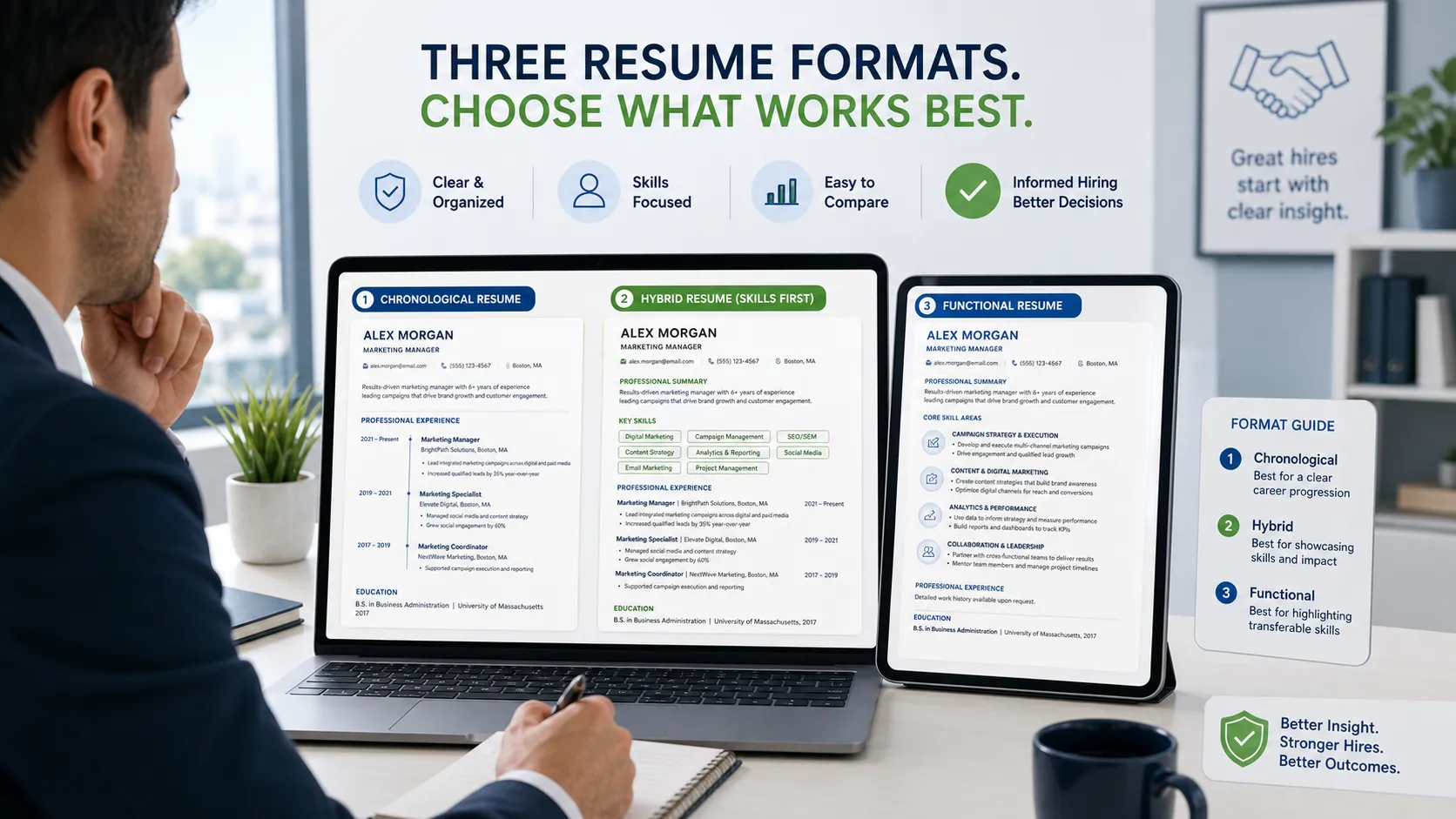
Chronological resume format explained
A chronological resume (more precisely, reverse-chronological) presents your work experience starting from your most recent role and moving backwards. It is the format most recruiters expect to see when they open a resume in 2026.
A typical chronological resume includes:
- A concise professional summary at the top.
- A work experience section ordered from most recent to oldest.
- An education section.
- A skills section tailored to the role.
Advantages of chronological resumes
Chronological resumes work best when your work history is stable and relevant to the role you are targeting.
Key advantages:
- Easy for recruiters to navigate and scan quickly.
- Shows a clear timeline of promotions, increased responsibilities and career growth.
- Aligns well with ATS expectations, which often parse resumes by job titles and dates.
Spend most of your resume real estate on your last 2–3 roles; they carry the most weight in 2026 hiring decisions.
When a chronological format is ideal
Use a chronological resume when:
- You have 3+ years of experience in the same or adjacent field.
- Your recent roles are directly relevant to the job you want.
- You want to highlight steady progression or internal promotions.
If this describes you, a chronological format will usually be the best resume format for 2026.
Hybrid (combination) resume format explained
A hybrid (also called combination) resume blends a strong skills-focused section at the top with a chronological work history below. Think of it as putting your most marketable skills and achievements in the spotlight, while still providing the dates and context recruiters need.
A typical hybrid resume includes:
- A summary headline.
- A key skills or "Core competencies" section with grouped skills and short achievement bullets.
- A chronological experience section with job titles, companies and dates.
- Education and certifications.
Advantages of hybrid resumes
Hybrid resumes are often the best choice for experienced professionals with complex or non-linear career paths.
Key advantages:
- Lets you highlight skills and outcomes that match the job description before recruiters see your job titles.
- Retains dates and company names, which builds trust and credibility.
- Works well for career changers and multi-specialists (for example, someone who has been both a developer and product manager).
A marketer who moved into product management can use a hybrid format to group "Growth strategy" and "Product analytics" achievements at the top, then show both marketing and PM roles chronologically below.
When a hybrid format is ideal
Use a hybrid resume when:
- You are changing careers but have transferable achievements.
- You have parallel experience (for example, consulting plus full-time roles).
- You have employment gaps but still want a transparent timeline.
In 2026, hybrid resumes are often the most ATS-friendly way to emphasize skills without hiding your history.
Functional (skills-based) resume format explained
A functional resume focuses almost entirely on skills and accomplishments, often grouping them into categories such as "Leadership", "Project Management" or "Technical Skills". Work history and dates, if present at all, are usually pushed to the bottom.
In theory, a functional format helps people with gaps or career changes emphasize skills instead of timelines. In practice, many recruiters treat functional resumes as a red flag.
Why functional resumes are risky in 2026
Functional resumes have several issues:
- They obscure when and where achievements happened, which makes it harder to judge seniority.
- Recruiters may assume the format is hiding job gaps, short stints or performance issues.
- Some ATS configurations expect a chronological structure and may misinterpret purely functional layouts.
When dates disappear, hiring teams naturally wonder what you are trying to hide. Use functional formatting very carefully.
When a functional format might still work
A functional resume can occasionally make sense if:
- You are at the very start of your career with minimal formal experience.
- You are returning to the workforce after a long break and most of your experience is project-based or freelance.
- You are applying in a niche creative field where portfolios carry more weight than titles.
Even in these cases, a hybrid format with a short, honest work history section is usually safer.
Chronological vs hybrid vs functional: comparison table
The table below summarizes the three main formats for 2026.
| Format | Primary focus | Best for | Main risk in 2026 |
|---|---|---|---|
| Chronological | Recent roles and timeline | Stable, relevant career paths | Less flexible for major career changes |
| Hybrid | Skills plus timeline | Career changers, complex paths, senior roles | Requires careful editing to avoid repetition |
| Functional | Skills only | Very early career, long breaks, select creative fields | High recruiter skepticism, ATS confusion |
For 2026 job searches, use chronological or hybrid formats by default. Save functional layouts for very specific edge cases.
Best format by common 2026 scenarios
You can think of resume formats as tools for specific situations. Here is a scenario-based guide.
| Scenario | Recommended format | Why it works |
|---|---|---|
| Mid-level professional with steady growth | Chronological | Highlights promotions and increasing responsibility clearly |
| Senior leader with cross-functional experience | Hybrid | Surfaces strategic skills while preserving an executive timeline |
| Career changer (for example, teacher to UX) | Hybrid | Emphasizes transferable projects and skills, still shows dates |
| Freelancer or consultant with many short gigs | Hybrid | Groups similar projects, then lists key engagements chronologically |
| Recent graduate with internships only | Chronological or light hybrid | Keeps things simple while still spotlighting relevant projects |
| Long employment gap (caregiving, travel) | Hybrid | Allows honest gap explanation with strong skills section upfront |
Clarify your 2026 career story
Before you choose a format, decide what story you want your resume to tell in 6–10 seconds of scanning.
Ask yourself:
- What role am I targeting right now?
- Which 3–5 achievements would convince a hiring manager that I can deliver results in this role?
- Does my existing timeline help or hurt that story?
If your timeline is an asset, choose a chronological format. If your skills and achievements are stronger than your job titles, lean towards hybrid.
Choose the best format for your situation
Once you have your story, use this quick decision guide:
- If your last two roles are highly relevant, choose chronological.
- If you have a mix of roles and want to pivot, choose hybrid.
- If you have almost no formal experience, start with chronological but allow a project-heavy experience section.
Your resume format cannot fix a vague target. First decide the exact type of role you want, then structure your resume to match it.
Optimize your resume for ATS and human readers
Regardless of format, 2026-ready resumes must work for both ATS and human recruiters.
Practical guidelines:
- Use clear section headings like "Experience", "Education", "Skills".
- Match job titles and key skills to the language in the job description (without keyword stuffing).
- Keep fonts and layout simple so parsing tools can read your text reliably.
Every bullet should show a result: "Improved X" is weak; "Increased qualified leads by 28 percent" is strong.
Sample hybrid resume for 2026
Below is a simplified hybrid resume example that would work well for a mid-level professional in 2026.
Data-driven marketing strategist with 8 years of experience in B2B SaaS. Specializes in lifecycle campaigns that turn trial users into long-term customers.
- Designed a multi-channel launch that increased product adoption by 35 percent in one quarter.
- Led quarterly experiments to optimize pricing and messaging across three regions.
- Built onboarding email sequences that lifted trial-to-paid conversion by 18 percent.
- Implemented segmentation logic that reduced churn among high-value accounts.
- Partnered with product and sales to define shared metrics and dashboard visibility.
- Translated analytics into clear, actionable recommendations for non-technical stakeholders.
- Own global lifecycle campaigns for a 50,000-plus user base.
- Manage a small team of specialists and agency partners.
- Led demand generation programs that consistently hit pipeline targets.
- Mentored junior marketers on experiment design and measurement.
- Ran email and webinar campaigns for new product launches.
- Collaborated with sales to refine messaging based on live feedback.
Bachelor of Business Administration, Major in Marketing
Lifecycle marketing, B2B SaaS, experimentation, analytics, cross-functional leadership
This hybrid layout ensures that even if a recruiter only reads the top half, they still understand Alex's strengths.
Sample cover letter that matches your resume
A strong cover letter should reinforce, not repeat, your resume.
Dear Hiring Manager,
I am excited to apply for the Senior Marketing Strategist role at your company. Over the past eight years in B2B SaaS, I have focused on building lifecycle programs that move users from first touch to loyal customer.
In my current role at Nimbus Cloud, I led a multi-channel launch that increased product adoption by more than a third in one quarter. I also designed onboarding journeys that significantly improved trial conversion and reduced churn. These outcomes came from close collaboration with product, sales and support.
I am particularly drawn to this role because of your emphasis on data-informed decisions and cross-functional alignment. I would welcome the opportunity to bring my experimentation mindset and lifecycle experience to your team.
Sincerely,
Alex Rivera
If you use a hybrid or chronological resume, keep your cover letter focused on one or two high-impact achievements that support the same narrative.
Common mistakes with resume formats in 2026
Even strong candidates lose traction because of avoidable formatting mistakes.
- Switching to a functional resume just to hide gaps.
- Using a different format for every application without a clear reason.
- Over-designing the layout so ATS cannot parse the text.
Other frequent problems:
- Mixing multiple formats on one page (for example, a functional top with inconsistent dates below).
- Burying your most recent role under long lists of older jobs.
- Using generic section headings that do not help scanners (for example, "Background" instead of "Experience").
Advanced tips for 2026 job seekers
Once your resume format is solid, refine how you present your achievements.
Advanced tactics:
- Use one format consistently across your resume, LinkedIn profile and portfolio.
- Maintain a "master" hybrid resume with everything, then tailor versions for specific roles.
- For senior positions, add a short "Career snapshot" section that shows title progression.
Ask yourself: if someone searched for this role in an ATS, would my job titles and skills actually match the filters?
FAQ
What is the best resume format for 2026?
For most professionals, a reverse-chronological or hybrid resume is the best format for 2026 because it is familiar to recruiters, works well with ATS, and clearly shows recent experience and achievements.
When should I use a hybrid resume instead of a chronological one?
Use a hybrid resume when you are changing careers, have a mix of roles or freelance projects, or need to highlight specific skills at the top while still providing a transparent work history.
Are functional resumes still acceptable in 2026?
Functional resumes are rarely the best choice in 2026. They can raise questions about what you are trying to hide and make it harder for recruiters and ATS to understand your timeline. A hybrid resume usually offers similar benefits with fewer risks.
How does ATS affect my choice of resume format?
ATS tools scan for clear sections, job titles, dates and keywords. Chronological and hybrid formats naturally align with these expectations, while heavily functional layouts can confuse parsing and lower your chances of ranking well.
Can I change my resume format for different roles?
Yes. It is wise to maintain a master hybrid or chronological resume and create targeted versions for different roles. The key is to change format intentionally, based on the story you need to tell for each opportunity.