How to Write a Resume That Gets Interviews: A Complete Step-by-Step Guide
Most resumes do not fail because the candidate lacks value. They fail because the value is difficult to find.
A strong resume makes three things clear within moments: what you do, what you do well, and why that matters for this role. It is not a complete biography, a list of every task you have performed, or a design exercise. It is a focused business document that helps an employer decide whether to interview you.
This guide takes you from a blank page to a polished, ATS-friendly resume. You will learn how to choose the right format, write stronger achievement bullets, tailor your content without rewriting everything, and handle difficult situations such as limited experience, career changes, employment gaps, and promotions.
Do not try to include everything. Include the most relevant evidence that proves you can succeed in the target job.
What makes a good resume?
A good resume works for both scanning and deeper reading. A recruiter should be able to understand your direction quickly, while a hiring manager should find enough evidence to trust your claims.
| Employer question | What your resume should show | Strong evidence |
|---|---|---|
| Can this person do the job? | Relevant skills and experience | Similar projects, responsibilities, tools, or environments |
| Have they produced results? | Achievements, not only duties | Revenue, time, quality, cost, growth, scale, accuracy, or risk improvements |
| Is their background credible? | Clear progression and consistent details | Dates, job titles, employers, education, certifications |
| Do they understand this role? | Tailored language and priorities | Skills and examples that match the job description |
| Is the resume easy to review? | Clean structure and readable formatting | Standard headings, concise bullets, balanced white space |
A polished resume usually has five qualities:
- Relevant: It focuses on the role being pursued.
- Specific: It replaces broad claims with concrete evidence.
- Readable: It uses a clean hierarchy and consistent formatting.
- Credible: It avoids exaggeration and makes results believable.
- Adaptable: It can be tailored efficiently for different applications.
Before you start: create a master career inventory
Writing directly into a one-page template often causes people to forget valuable examples. Start with a private master document that can be as long as necessary.
Collect:
- Every job title, employer, location, and employment date
- Major responsibilities and recurring areas of ownership
- Projects, launches, migrations, improvements, and difficult problems
- Promotions, awards, certifications, and formal recognition
- Tools, platforms, methods, languages, and industry knowledge
- Numbers that show scale, speed, quality, cost, revenue, or efficiency
- Positive feedback from customers, managers, colleagues, or partners
- Education, relevant coursework, volunteer work, and independent projects
Do not worry about elegant wording yet. Your goal is to recover the evidence first. Writing becomes much easier once the raw material is visible.
For each important project, write what the situation looked like before you became involved, what you changed, and what improved afterward. This often reveals stronger achievements than asking, “What were my duties?”
Define the exact job you are targeting
A resume written for “anything in marketing” or “any technology role” usually becomes too broad to be persuasive. Choose a clear target before deciding what to include.
Write down:
- Target job title
- Seniority level
- Industry or company type
- Core skills the role requires
- Problems the employer expects this person to solve
- Evidence from your background that matches those needs
Then review several relevant job descriptions. Look for repeated requirements rather than copying the language of one employer. Separate the requirements into four groups:
| Requirement type | Examples | Where it may appear on your resume |
|---|---|---|
| Role expertise | Financial analysis, customer success, cloud infrastructure | Summary, experience, skills |
| Tools and platforms | Excel, Salesforce, Kubernetes, Figma | Skills and achievement bullets |
| Business outcomes | Retention, cost control, delivery speed, compliance | Experience bullets |
| Working style | Stakeholder management, leadership, communication | Experience bullets with context |
The target role should influence the order, emphasis, and wording of your resume. It should never change the truth.
Use the employer's terminology only when it accurately describes your experience. Keyword stuffing, copied sentences, and unsupported claims make a resume less credible.
Choose the best resume format
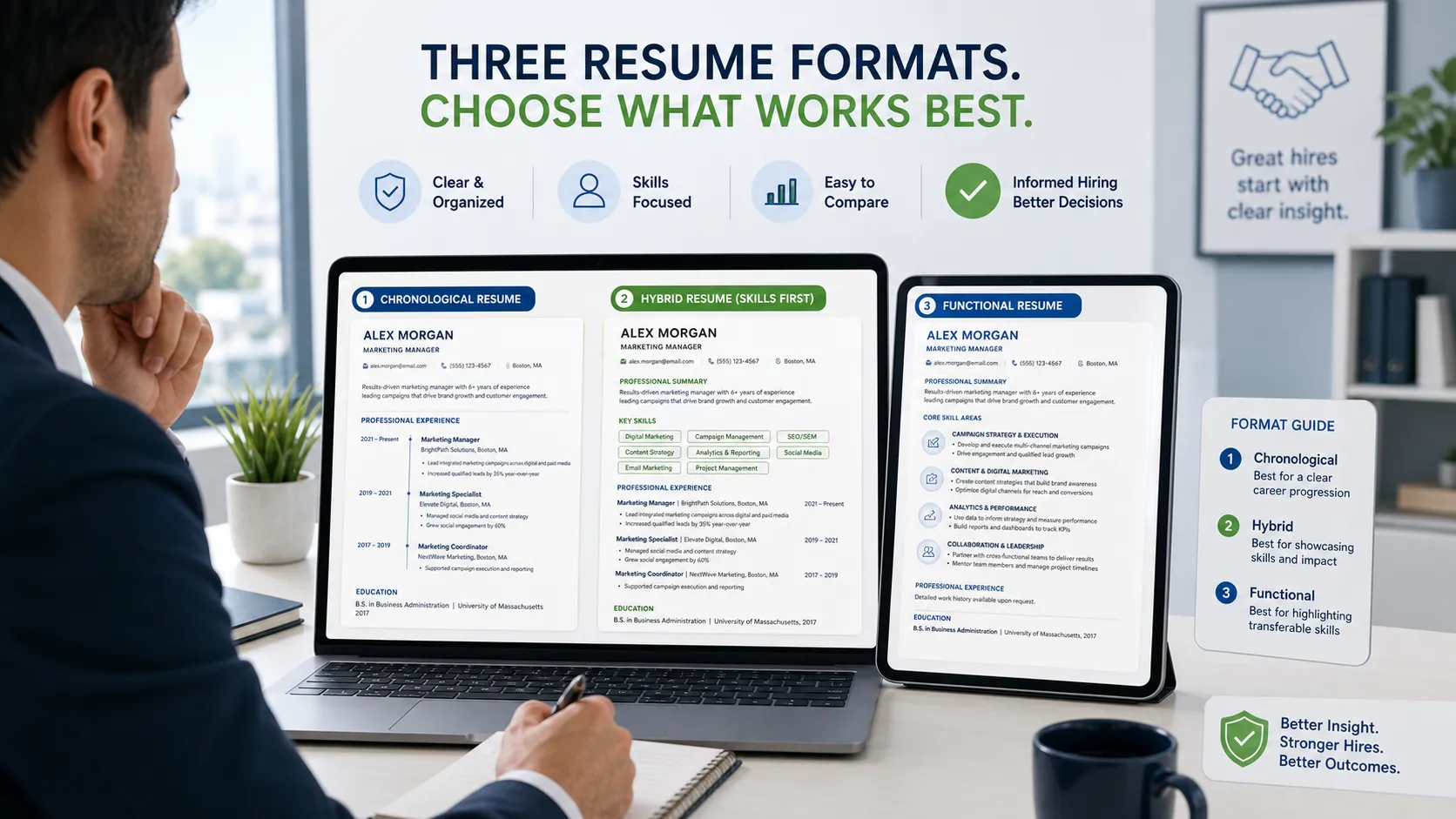
The format determines what the reader sees first. For most candidates, the reverse-chronological format is the strongest choice because it presents recent experience clearly and makes career progression easy to follow.
| Resume format | Best for | Main advantage | Main risk |
|---|---|---|---|
| Reverse chronological | Most professionals with a clear work history | Familiar, credible, and easy to scan | Makes gaps or frequent moves more visible |
| Combination | Career changers, specialists, or candidates with highly relevant skills | Balances capabilities with employment history | Can become repetitive or too long |
| Functional | Rare cases where skills matter far more than job chronology | Leads with transferable abilities | Employers may struggle to understand where and when skills were used |
Reverse-chronological resume
This format lists your most recent position first, followed by earlier roles. It is usually the safest default for experienced professionals, graduates with internships, and candidates progressing within one field.
Combination resume
A combination resume places a focused skills or selected-achievements section before the full work history. It can help when your most relevant experience comes from several roles, freelance work, military service, or a different industry.
Functional resume
A functional resume organizes content mainly around skill categories. Use it carefully. Skills are more convincing when the reader can connect them to a real employer, project, date, or result.
An employer should not need to decode your structure. A familiar format lets the content—not the layout—do the persuasive work.
Set the page structure and visual hierarchy
Your resume should look calm, deliberate, and easy to navigate. Good design reduces friction; it does not compete with the content.
Use:
- A readable professional font
- Clear section headings
- Consistent date and location formats
- Predictable spacing between roles and sections
- Short paragraphs and concise bullet points
- Enough white space to separate ideas
- A restrained use of bold text for names, titles, and key details
Avoid:
- Dense blocks of text
- Decorative icons replacing important labels
- Skill-rating bars or stars
- Multiple competing accent colors
- Tiny text used to force content onto one page
- Important information placed only inside graphics
- Headers or footers containing essential contact details
Recommended section order
The strongest order depends on the candidate.
| Candidate profile | Recommended order |
|---|---|
| Experienced professional | Header, headline, summary, skills, experience, education, additional sections |
| Recent graduate | Header, objective or summary, education, skills, projects, experience |
| Career changer | Header, target headline, summary, relevant skills, selected achievements, experience, education |
| Technical specialist | Header, headline, summary, technical skills, experience, projects or certifications, education |
| Academic or research candidate | A resume may not be the right document; an academic CV may require a different structure |
How long should the resume be?
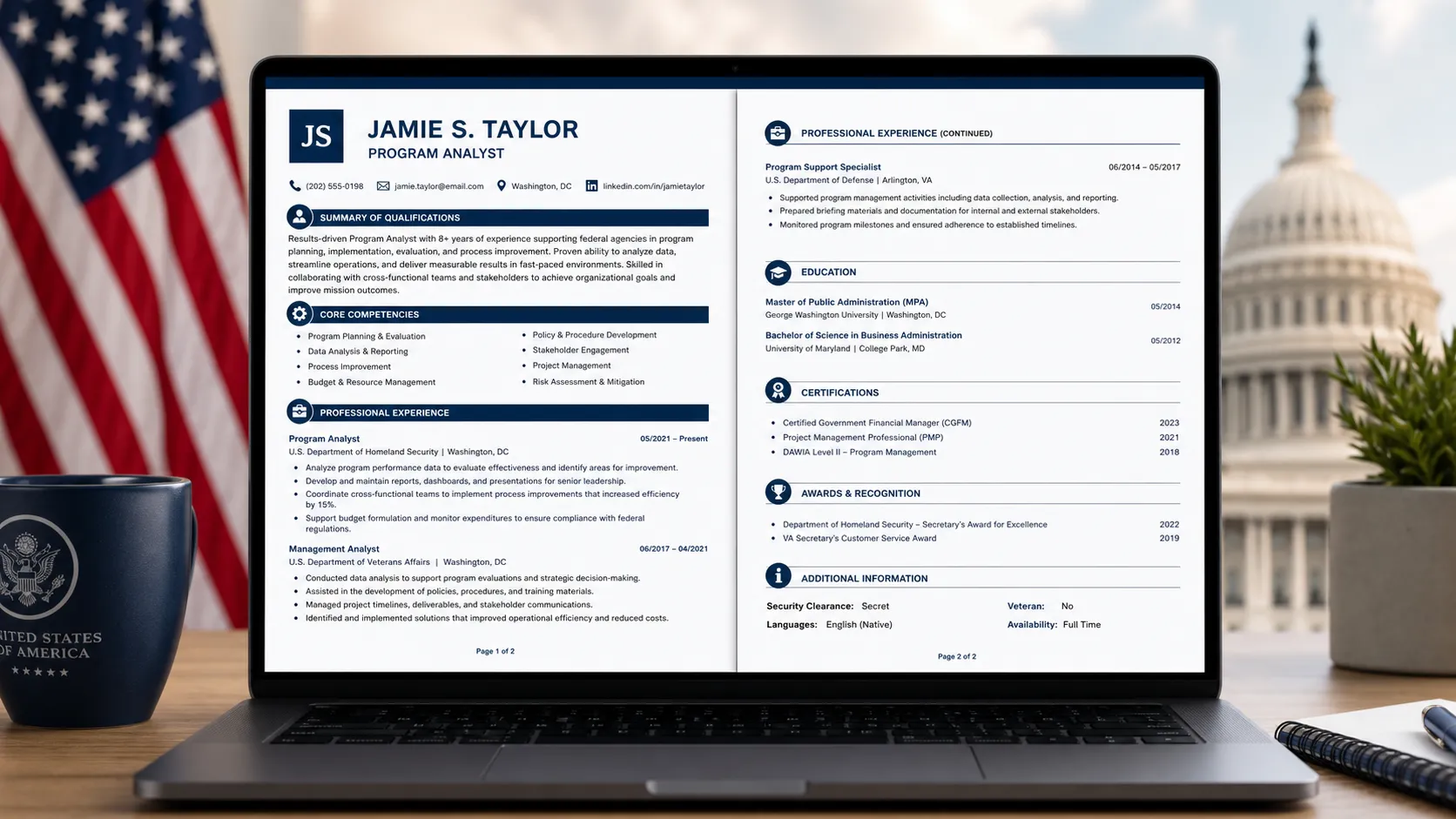
Use one page when it presents your strongest case without removing important evidence. Use two pages when the additional content is relevant and helps prove your fit.
Do not treat one page as a universal rule. A crowded one-page resume is often harder to read than a focused two-page resume. At the same time, length should come from useful evidence, not repetition.
Ask whether the information helps the employer understand your fit, credibility, or results. If it does not, shorten it or remove it.
Write a clear resume header
The header should help the employer identify and contact you without searching.
Include:
- Full name
- Professional phone number
- Professional email address
- City and region or country
- Portfolio or professional profile only when relevant
- Work authorization or relocation note only when it solves a likely concern
You usually do not need:
- Full street address
- Photograph, unless it is standard and appropriate in your market
- Date of birth
- Marital status
- Identification numbers
- Multiple phone numbers
- An email address that looks informal or outdated
A simple header is enough:
Maya Chen
Lisbon, Portugal | +351 900 000 000 | maya.chen@email.com
Use the same name across your application documents and professional profiles. If you use a shortened professional name, keep it consistent.
Add a specific professional headline
A headline sits below your name and immediately positions you for the target role. It is especially useful when your official job title is vague, internal, or different from the title employers search for.
Weak headline:
Experienced Professional Seeking New Opportunities
Stronger headline:
Senior Customer Success Manager | B2B SaaS | Retention and Expansion
Another strong headline:
Cloud Platform Engineer | AWS, Kubernetes and Terraform
The headline should be accurate. Do not promote yourself to a title you have never held or cannot support. You can use a target-oriented version when it reflects the work you already perform.
Use target role + specialization + high-value capability. Keep only the parts that improve clarity.
Write a professional summary or objective
A summary is a short introduction for candidates who already have relevant experience. An objective is more useful when you are entering the workforce, changing careers, or returning after a long break.
Professional summary formula
Use this structure:
Professional identity + relevant experience + area of strength + proof of value + target context
Weak summary:
Hardworking and results-driven professional with excellent communication skills. Team player who works well under pressure and is looking for a challenging position.
This could describe almost anyone. It gives the employer no reason to keep reading.
Stronger summary:
Customer success leader with seven years of experience supporting B2B software accounts across Europe. Built onboarding and adoption programs for portfolios exceeding 80 customers, improved renewal visibility, and partnered with sales and product teams to protect expansion opportunities. Strong background in stakeholder communication, health scoring, and complex account recovery.
Resume objective formula
Use this structure:
Current background + transferable strength + relevant evidence + contribution you want to make
Example:
Operations coordinator transitioning into project management after five years of scheduling vendors, controlling budgets, and delivering multi-site improvement projects. Completed formal project management training and led a recent office relocation involving 12 suppliers and four internal teams. Seeking to bring structured planning and stakeholder coordination to a junior project manager role.
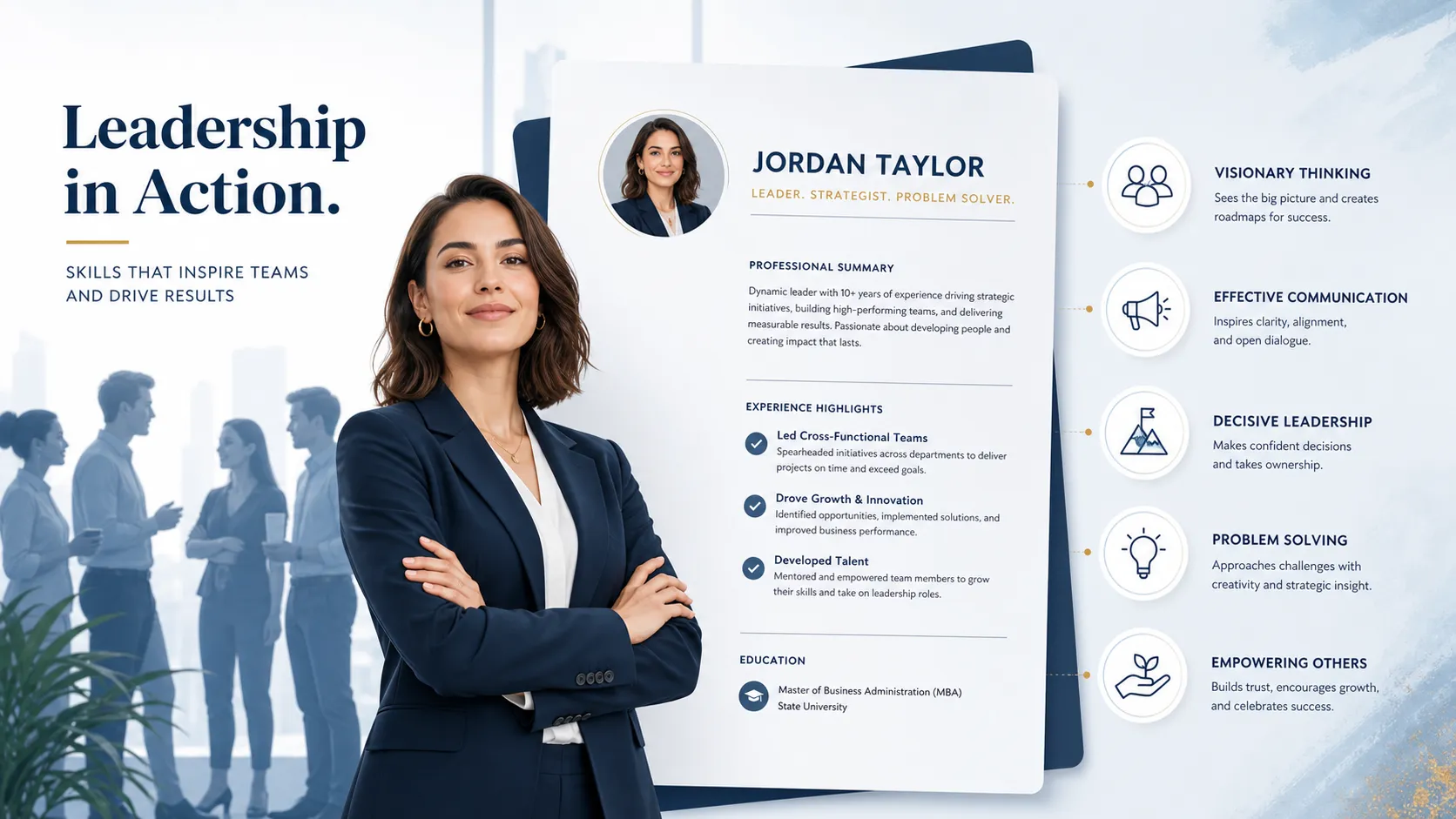
Keep the summary or objective focused. Three or four lines are usually enough. Remove empty adjectives such as “dynamic,” “passionate,” and “motivated” unless the surrounding sentence proves them.
Turn work experience into evidence
The experience section carries most of the persuasive weight for experienced candidates. Each role should establish context and then show contribution.
Use this structure:
Job Title
Company | Location | Dates
Add a one-line role description only when the company, product, team, or scope is not obvious. Then use achievement-oriented bullets.
What belongs in a strong bullet?
A useful bullet normally includes some combination of:
- A strong action
- What you changed, built, delivered, improved, or solved
- The scope or difficulty
- The method or skill used
- The result or business value
A practical formula is:
Action + task or problem + method or scope + result
Before-and-after examples
| Weak bullet | Stronger bullet |
|---|---|
| Responsible for customer onboarding | Redesigned customer onboarding into a six-week milestone plan, reducing delayed launches and giving account teams a consistent handoff process |
| Helped with monthly reports | Automated monthly performance reporting across five business units, cutting preparation from two days to three hours |
| Managed social media accounts | Planned and delivered a 12-week content calendar across three channels, increasing qualified demo enquiries while reducing last-minute production work |
| Worked on cloud infrastructure | Standardized reusable infrastructure modules for application teams, reducing environment setup time and configuration drift |
| Answered customer complaints | Resolved complex billing and delivery escalations, identified recurring causes, and helped operations remove two high-volume failure points |
Notice that the stronger versions explain what changed. A number can improve a bullet, but only when the number is meaningful and defensible.
Use numbers with context
Useful measurements include:
- Revenue gained or protected
- Costs reduced or avoided
- Time saved
- Cycle time reduced
- Output increased
- Accuracy or quality improved
- Customer retention or satisfaction
- Team, customer, budget, or geographic scope
- Availability, reliability, or response time
- Risk, incidents, or defects reduced
A precise-looking number does not make an unsupported claim credible. When exact data is unavailable, describe the scale, frequency, complexity, or observable outcome honestly.
How many bullets per role?
Give more space to recent and relevant roles. A current or highly relevant position may need four to six bullets. Older or less relevant roles may need one to three. Very old experience can sometimes be summarized in an “Additional Experience” section.
Show promotions clearly
When you held multiple roles at one company, group them under the employer so the progression is obvious.
Northstar Software | Lisbon, Portugal
Senior Implementation Manager | 2024–Present
Implementation Manager | 2021–2024
This structure shows advancement without repeating the company information.
Build a focused skills section
The skills section supports your experience; it does not replace it. Prioritize skills that are relevant, specific, and supported elsewhere in the resume.
Good skill categories may include:
- Technical skills
- Tools and platforms
- Methods and frameworks
- Languages
- Industry knowledge
- Certifications and licenses
Hard skills versus soft skills
| Skill type | Examples | Best way to present it |
|---|---|---|
| Hard skill | Financial modeling, Python, paid search, contract negotiation | Skills section plus evidence in experience |
| Tool or platform | Salesforce, AWS, Adobe Creative Cloud, Excel | Grouped skills section and relevant bullets |
| Method | Agile delivery, root-cause analysis, user research | Experience bullets showing application |
| Soft skill | Leadership, communication, prioritization | Demonstrated through actions and outcomes |
| Language | Portuguese, English, German | Language section with honest proficiency |
Avoid long lists of broad traits such as “teamwork, communication, problem-solving, hard-working.” Employers expect these qualities, and a list alone does not prove them.
A better approach is to demonstrate the skill:
- Communication: Presented technical migration risks to senior stakeholders and secured approval for a phased rollout.
- Leadership: Coordinated a cross-functional launch team across product, operations, support, and sales.
- Problem-solving: Traced recurring order failures to a validation gap and partnered with engineering to remove the root cause.
When a job description says “stakeholder management” and that accurately describes your work, use that phrase. When you have only observed a tool or method, do not list it as a working skill.
Present education at the right level of detail
Include:
- Degree or qualification
- Field of study
- Institution
- Location, when useful
- Graduation year, expected graduation year, or attendance dates when relevant
For experienced professionals, the education section is usually concise. Recent graduates can add relevant coursework, academic projects, honors, leadership, or a strong grade when it supports the application.
Example:
MSc, Information Systems
University of Lisbon | 2024
Recent graduate example:
BSc, Business Analytics
University of Manchester | 2026
Relevant coursework: Forecasting, database systems, operations research
Capstone: Built a demand-planning model for a regional food distributor
Do not list every school-level qualification once higher education and professional experience make it unnecessary, unless the employer specifically requests it.
Add supporting sections only when they strengthen your case
Optional sections can differentiate you, but they should earn their space.
Useful options include:
- Certifications
- Selected projects
- Publications
- Awards
- Volunteer experience
- Professional memberships
- Languages
- Conferences or speaking
- Patents
- Security clearance
- Relevant interests
Projects
Projects are valuable for students, career changers, freelancers, technical candidates, and anyone whose strongest evidence exists outside a formal job.
A strong project entry includes:
- Project name
- Your role
- The problem or objective
- Methods, tools, or constraints
- Outcome or deliverable
Example:
Inventory Forecasting Project | Independent
Built a weekly forecasting model using three years of sales history, documented assumptions, and created a dashboard that compared forecast error by product category.
Certifications
List the certification name, issuing organization, and year when useful. Prioritize current and role-relevant credentials. Avoid placing short online course certificates above stronger professional experience.
Volunteer experience
Treat meaningful volunteer work like professional experience. Show ownership, scope, and outcomes instead of listing the organization alone.
A small project that proves the exact skill an employer needs can be more useful than an impressive but unrelated activity.
Tailor the resume for each job
Tailoring does not mean rewriting every sentence. It means changing emphasis so the most relevant evidence is easiest to find.
A practical tailoring workflow
- Highlight the employer's essential requirements.
- Mark which requirements you can prove.
- Identify the strongest example for each important requirement.
- Move high-value evidence higher in the resume.
- Adjust the headline and summary.
- Reorder skills to match the role.
- Rewrite a few bullets so the relevant result or method is explicit.
- Remove content that distracts from the target.
- Check that the language remains natural and truthful.
Use a simple evidence map:
| Job requirement | Your evidence | Resume location | Action needed |
|---|---|---|---|
| Lead enterprise implementations | Managed multi-region rollout for 24 client teams | Current role, bullet 2 | Move higher |
| Executive communication | Presented risk and progress updates to directors | Current role, bullet 5 | Make audience explicit |
| Salesforce experience | Used daily for pipeline and account planning | Skills and two roles | Keep |
| Healthcare experience | None | — | Do not claim; emphasize transferable regulated-environment work |
Match meaning, not only words
A job description may use “vendor management” while your resume says “managed external suppliers.” When the meaning is the same, use the employer's standard terminology where it improves clarity.
Do not force every keyword into the summary. Important terms should appear in the sections where they make sense and where your experience supports them.
Original: “Coordinated external partners for office projects.”
Tailored: “Managed six facilities vendors across maintenance, security, and office improvement projects, including contract tracking and service reviews.”
Make the resume ATS-friendly
An applicant tracking system can store, parse, search, and organize applications. Your resume should be structured so important information can be extracted accurately, while still reading well for a person.
ATS-friendly practices
- Use standard section names such as Summary, Experience, Skills, and Education
- Keep job titles, company names, and dates easy to identify
- Use text-based PDF or DOCX files rather than scanned images
- Follow the file type requested in the application
- Use familiar fonts and readable sizes
- Place keywords naturally in context
- Spell out an important term at least once when the acronym may be ambiguous
- Keep contact information in the main document body
- Test copied text to confirm the reading order is logical
Formatting that can create problems
- Essential text inside images
- Complicated text boxes
- Unusual section labels
- Decorative timelines
- Multi-column layouts with confusing reading order
- Icons without text labels
- Tables used to hold the entire resume
- Scanned or image-only files
A visually designed resume may still work in some contexts, particularly when sent directly to a person. For online applications, a clean and structurally simple version is the safer choice.
Hidden keywords, white text, copied job descriptions, and keyword repetition can damage readability and trust. The goal is accurate matching, not manipulation.
Handle special resume situations strategically
Resume with no work experience
Use evidence from:
- Education
- Coursework
- Academic projects
- Volunteer work
- Internships
- Freelance assignments
- Personal projects
- Student organizations
- Sports leadership
- Family business responsibilities
- Caregiving or community responsibilities when relevant
Focus on what you produced, organized, researched, improved, or learned.
Weak:
“Completed a marketing group project.”
Stronger:
“Led a four-person market-entry project, analyzed survey responses from 180 participants, and presented pricing recommendations to a faculty panel.”
Career change
Do not hide your previous career. Translate it.
A teacher moving into customer success may already have experience in onboarding, communication, retention, conflict resolution, progress tracking, and stakeholder management. The resume should connect those capabilities to the new role while showing evidence of any new technical or industry knowledge.
Use:
- A target headline
- A clear objective or summary
- A selected skills section
- Relevant achievements from previous roles
- Projects, training, or certifications that support the transition
Employment gaps
A gap does not need a long defense on the resume. Use clear dates and include meaningful activity when it adds value, such as study, caregiving, consulting, travel, volunteering, or personal projects.
Examples:
Career Break | Family Care | 2024–2025
Professional Development | Data Analytics Coursework and Portfolio Projects | 2025
Keep the wording neutral. The resume should focus on readiness and relevance.
Freelance or contract work
Group related assignments under one heading when listing every short contract would create clutter.
Independent Marketing Consultant | 2023–Present
Then describe representative clients, project types, scope, and outcomes without disclosing confidential information.
Multiple short-term roles
Label fixed-term, temporary, seasonal, or contract positions accurately. The context prevents normal project-based work from looking like unexplained job-hopping.
Returning to work
Lead with current capability. Add recent learning, projects, volunteer work, or freelance work when it demonstrates that your skills remain active.
Clear labels, honest dates, and relevant evidence usually work better than a defensive paragraph.
Edit for clarity, credibility, and impact
Your first draft gathers information. Editing turns it into a resume.
Remove weak language
Cut phrases such as:
- Responsible for
- Helped with
- Worked on
- Involved in
- Duties included
- Hardworking
- Results-oriented
- Go-getter
- Excellent communication skills
Replace them with precise actions and context.
Start bullets with varied action verbs
Choose verbs that match the contribution:
| Contribution | Useful verbs |
|---|---|
| Built or created | Built, designed, launched, developed, established |
| Improved | Streamlined, optimized, strengthened, reduced, accelerated |
| Led | Led, directed, coordinated, mentored, facilitated |
| Analyzed | Analyzed, evaluated, investigated, forecasted, identified |
| Delivered | Implemented, completed, shipped, executed, rolled out |
| Influenced | Advised, presented, negotiated, aligned, secured |
Do not replace every verb with an inflated synonym. “Used” can be clearer than “leveraged,” and “led” can be stronger than “spearheaded” when the sentence is specific.
Check every bullet
Ask:
- What did I actually do?
- Why was it important?
- What changed?
- How large or difficult was it?
- Which skill does it prove?
- Is this relevant to the target job?
- Can I defend the claim in an interview?
Read for rhythm
Resume bullets should not all sound identical. Mix shorter outcome-led bullets with slightly longer bullets that explain complex work. Remove repeated openings and unnecessary words.
Strategically spearheaded the successful implementation of innovative, best-in-class operational process enhancements across diverse cross-functional stakeholder groups.
Led a cross-functional redesign of the returns process, cutting approval delays and giving customer support a single escalation path.
Proofread, test, and save the final file
Proofreading is not only a spelling check. It is a consistency and usability review.
Content check
- Target role is clear
- Summary matches the rest of the resume
- Important requirements are supported by evidence
- Bullets focus on contribution and results
- Dates and job titles are accurate
- Metrics can be defended
- No confidential information is exposed
Formatting check
- Section headings are consistent
- Dates follow one format
- Punctuation is consistent across bullets
- Spacing is balanced
- Text is readable at normal zoom
- Page breaks do not split entries awkwardly
- Contact details are correct
Technical check
- File opens correctly
- Text can be selected and copied
- Reading order remains logical when pasted into plain text
- File name is professional
- Requested file format is used
- Final document contains no comments or tracked changes
Use a file name such as:
Maya-Chen-Customer-Success-Resume.pdf
Avoid:
resume-final-new-v7-really-final.pdf
When a posting requests a specific file type, naming convention, or set of documents, that instruction takes priority over general advice.
Complete resume example
The following example shows how the sections work together. The candidate is targeting a senior customer success position in B2B software.
```resume
Maya Chen
Senior Customer Success Manager
Lisbon, Portugal | +351 900 000 000 | maya.chen@email.com
Summary
Customer success leader with seven years of experience managing B2B software accounts across Europe. Built scalable onboarding and account-health practices for portfolios of up to 85 customers, improved renewal visibility, and partnered with sales and product teams to protect retention and expansion opportunities.
Core Skills
Customer success strategy, enterprise onboarding, account planning, renewals, expansion, executive business reviews, customer health scoring, escalation management, stakeholder communication, Salesforce, Gainsight
Experience
Senior Customer Success Manager, Northstar Software | 2023–Present
- Manage a portfolio of 42 enterprise customers across financial services, retail, and logistics, coordinating success plans from onboarding through renewal
- Redesigned the first 90 days of onboarding around agreed milestones, ownership, and risk reviews, reducing delayed launches across the portfolio
- Introduced a renewal-readiness process combining product adoption, support risk, stakeholder engagement, and commercial status
- Recovered three high-risk strategic accounts by aligning executive sponsors, product specialists, and support owners around documented action plans
- Built a quarterly customer insight review that gave product teams clearer evidence for prioritizing recurring workflow issues
- Mentor four customer success managers on discovery, account planning, and executive communication
Customer Success Manager, Northstar Software | 2020–2023
- Managed 70–85 mid-market accounts and maintained structured success plans for adoption, risk, and renewal activity
- Created reusable onboarding workshops and customer training materials, improving consistency across new account launches
- Partnered with sales on expansion discovery and prepared value summaries for commercial reviews
- Identified recurring reporting gaps and helped define dashboard improvements used by the wider customer base
Account Coordinator, Brightline Services | 2018–2020
- Coordinated client requests, delivery schedules, and internal handoffs for a portfolio of professional-services accounts
- Built a shared status tracker that reduced missed follow-ups and improved visibility across account, finance, and delivery teams
- Prepared monthly service reports and supported quarterly client reviews
Education
BSc, Business Management, University of Leeds | 2018
Certifications
Customer Success Management Certification | 2024
Salesforce Administrator | 2022
Languages
English — Fluent
Portuguese — Professional working proficiency
Mandarin — Native
```
A fast resume-writing method when you are short on time
When an application deadline is close, use this focused workflow:
- Choose the closest existing resume version.
- Read the job description once for context.
- Read it again and mark essential requirements.
- Select the top five requirements you can prove.
- Update the headline and summary.
- Move the most relevant skills and bullets higher.
- Rewrite two to four bullets to make the match explicit.
- Remove one or two distracting details.
- Run the final content and formatting checks.
- Save with a professional file name.
This approach is faster and stronger than starting from an empty document for every job.
Common resume mistakes and how to fix them
| Mistake | Why it hurts | Better approach |
|---|---|---|
| Using one resume for every role | Relevant evidence may be buried | Tailor the headline, summary, skills, and selected bullets |
| Listing duties without outcomes | The employer cannot see your impact | Explain what changed because of your work |
| Adding every past job | Important experience loses space | Prioritize recent and relevant roles |
| Writing a long summary | The opening becomes difficult to scan | Keep only identity, strengths, evidence, and direction |
| Overusing keywords | Writing sounds unnatural and untrustworthy | Use accurate terms in meaningful context |
| Using skill bars | Ratings are subjective and difficult to interpret | List skills and prove them in experience |
| Hiding employment dates | Creates uncertainty | Use clear, honest dates and contextual labels |
| Shrinking the font | Makes the document uncomfortable to read | Edit content or use a second page |
| Including private personal details | Adds risk without improving fit | Include only professional contact information |
| Sending the wrong file | Suggests poor attention to instructions | Check the posting before submission |
| Using an image-only document | Content may not parse or copy correctly | Export a text-based file |
| Leaving small inconsistencies | Weakens the impression of care | Standardize dates, punctuation, spacing, and capitalization |
Fix the target, evidence, and relevance before spending time on visual polish.
Final resume checklist
Use this checklist before every application.
Strategy
- The target role is immediately clear
- The resume reflects the employer's most important needs
- The strongest evidence appears in the upper half of the document
- Irrelevant content has been reduced or removed
Content
- The summary is specific and supported
- Experience bullets show actions and outcomes
- Skills are relevant and credible
- Education and certifications are accurate
- Special circumstances are labeled clearly and neutrallyPresentation
- Headings and dates are consistent
- Font size is comfortable
- White space makes sections easy to scan
- Contact details are correct
- The document works in plain-text reading orderSubmission
- The requested file type is used
- The file name is professional
- No comments, hidden notes, or tracked changes remain
- The final version was opened and checked after export
The standard to aim for
The best resume is not the one with the most impressive vocabulary or the most elaborate template. It is the one that makes a well-supported argument quickly.
A hiring manager should finish the first scan knowing your professional direction. A deeper read should reveal evidence of how you work, what you have achieved, and why your experience is relevant. When every section supports that same message, the resume feels confident without trying too hard.
Build a master career inventory, tailor the evidence, write in clear language, and review the final document as carefully as any important professional deliverable. That process produces a resume you can defend in an interview—and one an employer can understand.
FAQ
How long should a resume be?
A resume should be long enough to present relevant evidence without repetition. One page often works for students, recent graduates, and professionals with a shorter history, while two pages can be appropriate for experienced candidates with substantial relevant achievements.
What is the best resume format?
The reverse-chronological format is the best default for most job seekers because it presents recent experience and career progression clearly. A combination format can help career changers or specialists lead with relevant capabilities while still providing a complete work history.
Should I include every job I have had?
No. Prioritize recent and relevant experience. Older or unrelated roles can be shortened, grouped under additional experience, or removed when they do not help the employer evaluate your fit.
Should I send my resume as a PDF or Word document?
Follow the employer's instructions first. A text-based PDF preserves the layout well, while a DOCX file may be requested by some application systems. Keep clean versions in both formats so you can submit the requested file.
How do I write a resume with no experience?
Use relevant evidence from education, academic projects, volunteer work, internships, freelance assignments, student leadership, and personal projects. Describe what you built, organized, researched, improved, or delivered rather than focusing on the absence of formal employment.