Why Your Resume Gets Zero Interviews In 2026 (And Exactly How To Fix It As A Self-Taught Developer)

The harsh truth: it is rarely about your talent
If you are a self-taught developer sending dozens of applications and hearing nothing back, the problem is usually not your intelligence, work ethic, or potential.
In 2026, most resumes fail because they are hard to map to a specific role, hard for ATS to parse cleanly, and too generic to feel like a clear solution to the hiring manager's problem.
Your goal is no longer just to look qualified.
Your goal is to look like the obvious answer to one very specific job.
You are building a targeted evidence sheet that says: I can ship value in this exact role, right now.
Why strong resumes still get ignored in 2026
Behind almost every ghosted application, there is a pattern:
- The resume is impressive but vague: the reviewer cannot instantly see how it matches this one role.
- The ATS either cannot read parts of it or cannot find the right keywords fast enough.
- The career story raises small risks: unclear level, messy dates, or gaps that are never addressed.
None of these problems are about raw skill.
They are about positioning, clarity, and structure.
Problem 1: You are not positioned for a specific role
Most self-taught developers write a resume to cover every possible opportunity: frontend, backend, full-stack, QA, DevOps, anything.
To a recruiter skimming hundreds of profiles, that reads as confusion, not flexibility.
Hiring teams are not shopping for potential.
They are shopping for someone who looks like a near-drop-in fit for the exact role they opened.
If your resume does not communicate a clear target, it becomes background noise.
If a stranger cannot answer what role you are targeting after reading the top three lines of your resume, it is under-positioned.
How to fix your positioning
- Pick one primary target for each version of your resume
- Junior backend developer (Python)
- Junior frontend developer (React)
- Junior full-stack developer (TypeScript)
- Rewrite your headline and summary to match that target
- Weak: Self-taught developer open to all opportunities
- Strong: Junior Backend Developer focused on Python APIs and database-heavy products
- Reorder your projects and experience so that the most relevant items appear first
- If the job is backend-heavy, a FastAPI project should beat a CSS playground at the top.
Define a sharp target
Before touching your bullets or layout, decide who this resume is for.
You can absolutely have multiple versions; you just cannot have one resume that pretends to be about everything.
Answer these questions on paper first:
- Which tech stack do I actually want to be hired for in the next 6 months
- What kind of team do I want to join (product startup, agency, enterprise, consulting)
- What problem do I want to be trusted with (dashboards, internal tools, APIs, frontends, data workflows)
Turn your answers into a one-line targeting statement and use that as your internal filter for every section of the resume.
If a skill, project, or detail does not support that target, it moves down or comes out.
Problem 2: Your resume does not speak ATS language
Applicant Tracking Systems are not mythical gatekeepers, but they are unforgiving about structure.
The majority of preventable rejections in 2026 still come from missing keywords and formatting choices that break parsing, especially multi-column layouts, tables, and content in headers or footers.
For self-taught developers, this hurts even more: you often have fewer traditional signals (degrees, big-name companies), so you cannot afford to lose points on structure.
If your contact info is in a page header, your experience is in side-by-side columns, or your skills live inside icons or graphics, assume an ATS will misread or ignore them.
The 2026 ATS-safe structure
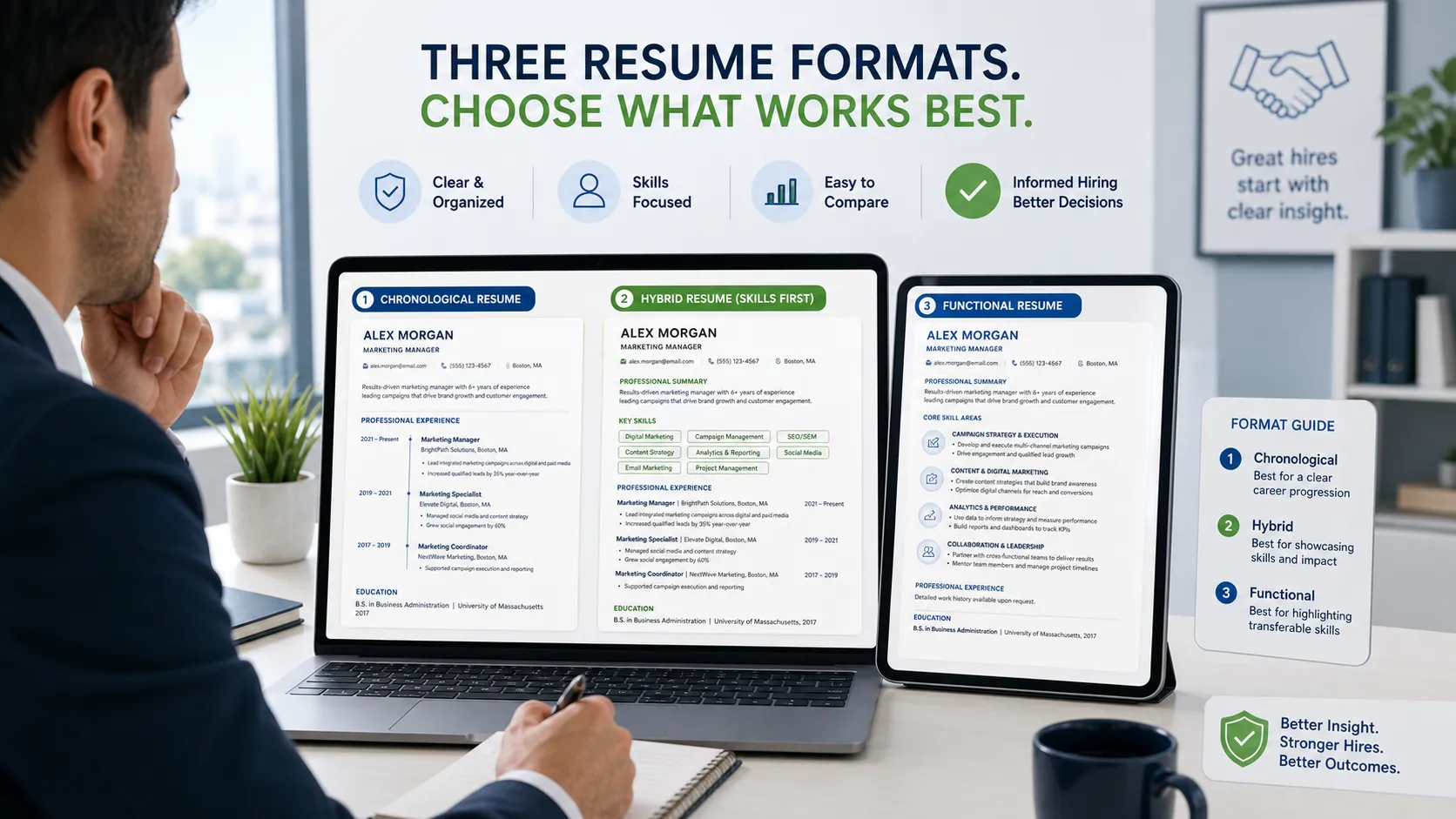
Use a clean, one-column layout with standard section headings:
- Name and contact (plain text, not in header or footer)
- Summary
- Skills
- Projects (for self-taught devs, this is often more important than experience)
- Experience (paid, freelance, internships, serious volunteer work)
- Education and certifications
No tables.
No text boxes.
No fancy graphics.
Just hierarchy, whitespace, and strong content.
Rebuild your resume for ATS and humans
Here is a simple structure you can follow today:
- Top section
- Name
- City and country (or open to remote)
- Email and phone
- GitHub and portfolio (only if they are clean and working)
- Summary (3 to 4 lines)
- Who you are
- Where you add value
- 2 to 3 proof points (metrics, shipped projects, stack)
- Skills
- Group by category: Languages, Frameworks, Tools, Cloud, Testing
- Keep it realistic: better to list fewer tools you can defend in an interview
- Projects
- 2 to 4 serious projects that match your target role
- Each with a short description, tech stack, and impact
- Experience
- Include relevant non-tech roles if they show ownership, customer work, or leadership
- Translate those into outcomes, not just duties
- Education and certifications
- Bootcamps, online programs, degrees, and notable courses
Problem 3: Your bullets describe activity, not impact
Most developer resumes are full of task-based bullets:
- Built a dashboard for internal users
- Worked on bug fixes and small features
- Contributed to company website
Those statements tell the reader almost nothing about the scale, complexity, or outcome of your work.
Hiring managers in 2026 scan for impact first: what changed because you were there.
Weak: Built a REST API for the app
Strong: Built a FastAPI backend handling 15k requests per day, cutting data export time from 5 minutes to under 30 seconds
The simple formula: problem → action → result
For each project or role, answer three questions:
- Problem: what was broken, slow, manual, or confusing before
- Action: what exactly did you design, build, or improve
- Result: what changed, ideally with a measurable outcome
Then compress that into one sharp bullet.
Do this for the top 2 to 3 bullets under each role or project.
Rewrite your bullets with real-world outcomes
Take one of your current roles or projects and run this process:
- List 5 to 10 things you actually did.
- For each, ask why it mattered.
- Add a simple metric or concrete detail (time saved, users served, errors reduced, money saved, performance improved).
- Keep the tech stack, but tie it to the outcome.
Examples tailored to a self-taught developer:
- Rebuilt a personal finance dashboard using React and TypeScript, reducing API errors by 40 percent and improving Lighthouse performance score from 72 to 94.
- Designed and deployed a FastAPI microservice on a cloud platform to automate CSV imports, cutting manual data entry by 6 hours per week for a small business client.
- Implemented unit tests with pytest on a portfolio project, catching regressions before deployment and simplifying refactors.
If a bullet would still be true without you specifically doing it (for example: responsible for updating the website), it is not strong enough yet.
Problem 4: Your projects and GitHub do not build trust
For self-taught developers, your portfolio and GitHub often carry more weight than your job titles.
Yet many candidates either point to abandoned repos, tutorial clones, or chaotic monoliths with no documentation.
Recruiters and hiring managers are busy.
They will not debug your portfolio.
If the first click leads to a broken demo or a repo with no README, you lose credibility instantly.
Link only what you are proud to have opened live in an interview.
No broken demos, no half-finished experiments, no unreviewed code dumps.
What a 2026-ready developer portfolio looks like
For each featured project:
- Clear one-line description of what it does and who it helps
- Brief list of tech used (for example: React, FastAPI, PostgreSQL, Docker)
- Short story of why you built it and what you learned
- Clean, well-structured code with sensible naming and directories
- README that explains how to run it locally, plus any tests or scripts
You do not need 20 projects.
You need 2 to 4 focused, relevant, and polished ones.
Curate your projects like a product manager
Treat your projects as case studies, not just code repositories.
For each one you keep on your resume, answer:
- Is this aligned with the stack in my target job
- Does it show I can own a small product from idea to deployment
- Would I be comfortable walking through the code and trade-offs in a live interview
If the answer is no, archive it quietly and build something sharper.
You will stand out more with three focused projects than with fifteen random experiments.
Instead of listing: Weather app, Todo app, Blog clone, Calculator app
List: Freelancer CRM mini-tool, Internal analytics dashboard for a side business, API-first microservice for CSV imports.
Problem 5: Your story feels risky or confusing
You might have employment gaps, career changes, or non-tech backgrounds.
None of these are automatic deal breakers.
What worries employers is ambiguity: they do not have time to guess why your timeline looks the way it does, and some ATS filters are harsh about gaps and missing dates.
Common risk signals:
- Long unexplained gaps with no visible learning or projects
- Job titles that bounce randomly (developer, then unrelated roles, then developer again) with no context
- Dates that use inconsistent formats or are missing entirely
How to reduce risk in your narrative
- Use consistent date formats across the entire resume.
- Briefly label periods of intensive self-study or project work as part-time experience or professional development.
- Add one line of context in your summary if you transitioned from another field (for example: After five years in finance, I transitioned into backend development through intensive self-study and applied projects).
You do need to show that you are serious, consistent, and shippable.
Make the top third of your resume do the heavy lifting
Most reviewers decide in seconds whether to keep reading.
If the top third of your resume is confusing, vague, or empty of proof, the rest often never gets attention.
Your top third should clearly answer three questions:
- What role are you aiming for
- What stack do you actually work with
- How do you know how to ship value (projects, clients, outcomes)
A strong 2026 developer summary
Here is a sample layout using the EliteResume fo is a sample layout using the EliteResume format:
Junior backend developer transitioning from operations, focused on building reliable APIs and automation tools.
Delivered 3 production-ready projects for small businesses using Python, FastAPI, and PostgreSQL.
Comfortable owning features end-to-end, from schema design to deployment and monitoring.
Python, FastAPI, Django, SQL, PostgreSQL, Redis, Docker, Git, Pytest, REST APIs, CI pipelines
Inventory Automation API – Designed and built a FastAPI service to sync orders between a webshop and a local POS, cutting manual data entry by 80 percent.
Analytics Dashboard – Implemented a metrics dashboard for a fitness studio using React and a Python backend, enabling daily tracking of member activity.
Adapt the details to your own background, but keep the same structure: clarity, stack, proof.
Align every section with the job description
We are in a keyword-driven hiring market.
The issue is not gaming the system; it is making sure your actual skills are described in the language the employer uses.
For each application:
- Scan the job description for repeated phrases
- Tools and frameworks (for example: React, Django, FastAPI, Kubernetes)
- Problem domains (for example: dashboards, internal tools, B2B SaaS, fintech)
- Responsibilities (for example: own features end-to-end, collaborate with designers, write tests)
- Select the most important 8 to 12 keywords
- Only choose ones you genuinely know or can defend in an interview.
- Mirror them naturally in your resume
- In your summary
- In your skills section
- Inside your project and experience bullets
It looks artificial and does not read well to humans.
Quick 10-minute audit: does your resume deserve an interview
Use this checklist before sending any application:
- Top third clearly states your target role and stack.
- Layout is single-column, clean, and free of tables, headers-footers content, and graphics.
- Skills match the role and are not bloated with tools you barely know.
- Projects show real problems, actions, and results, not just features.
- GitHub and portfolio links open quickly and point to curated, documented work.
- Dates are consistent and gaps are either short or explained through projects or learning.
- Summary reads like a value proposition, not an objective.
- Every bullet could be defended with a story in an interview.
If you cannot honestly check most of these boxes, fix them before sending your next application.
You will waste fewer applications and get clearer signal on what actually needs improvement.
FAQ
Do I really need multiple versions of my resume
In 2026, one generic resume is rarely enough.
If you are applying to both backend and frontend roles, you should have at least one version for each focus so that your summary, skills, and projects feel tightly aligned with the job.
How long should my resume be as a self-taught junior developer
If you are early in your career, one page is usually the right choice.
You want depth in a few strong projects and roles, not a long catalog of everything you have ever touched.
If you have several years of relevant experience in another field plus solid projects, a concise second page can be fine.
Should I list every technology I have tried
No.
Listing every tool you have ever experimented with makes it harder for hiring managers to understand your real strengths.
Focus on the stack you want to be hired for and the tools you are comfortable using to deliver value in a production context.
How important is GitHub for self-taught developers
Very important, but only if it is curated.
A small number of well-documented, actively maintained repositories aligned with your target roles will help far more than a noisy grid of abandoned tutorials.
What if I have no professional experience yet
Lean on projects as your primary proof and treat them like real work.
Include context, scope, and outcomes, and if you have done any freelance, volunteer, or community projects, present them in your experience section with clear results.
Even small, well-defined wins can build credibility.