Verified Reference Letters: A New Trust Layer for Job Applications
Verified reference letters are the missing trust layer in modern job applications
Resume tools have changed a lot. Candidates can now build cleaner resumes, optimize keywords, improve ATS compatibility, and write stronger cover letters in minutes.
But one important part of the job application process has barely changed at all: the reference letter.
Most reference letters are still ordinary PDF files. They may look professional, but they are difficult for recruiters to check. Was the letter approved by the referee? Is this the final version? Has the content been changed after approval? Is the reference still active, or did the referee later withdraw it?
EliteResume Verified References is built to solve that gap.
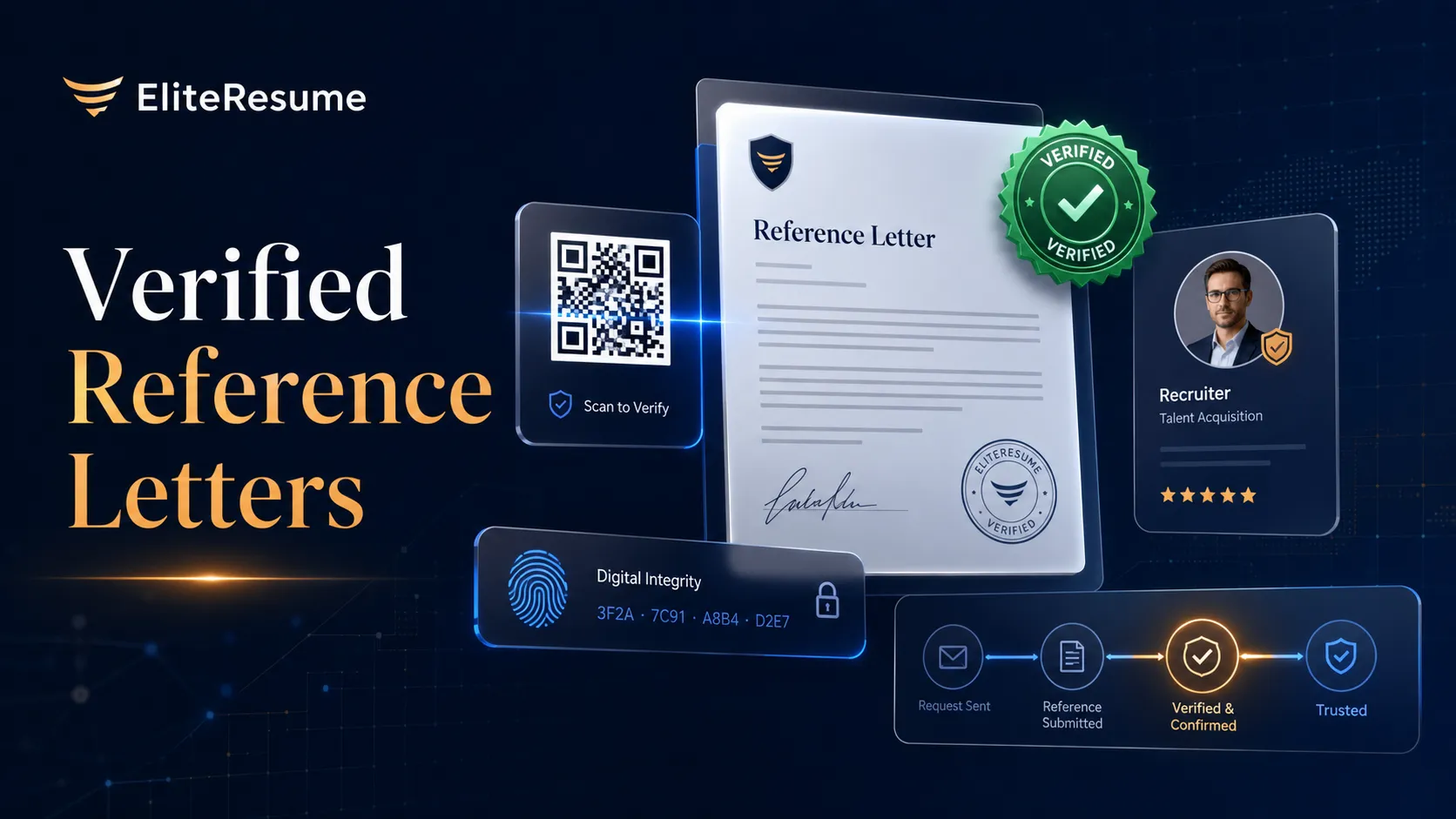
It turns a traditional reference letter into a recruiter-checkable career asset with email-confirmed approval, QR verification, live status, and document fingerprints. To our knowledge, this is one of the first resume-writing SaaS workflows to treat reference letters as verifiable professional proof instead of simple attachments.
A resume tells the hiring team what you claim. A verified reference helps show that a professional contact approved a supporting statement — and gives recruiters a practical way to check the approval record.
Why ordinary reference letters feel outdated
A classic reference letter usually follows a familiar pattern: a manager or colleague writes a few paragraphs, signs the letter, exports it as a PDF, and sends it to the candidate.
That can still be useful. A thoughtful recommendation can add credibility, especially when the candidate is applying for senior, remote, international, client-facing, or trust-sensitive roles.
The problem is not the idea of reference letters. The problem is the format.
| Traditional reference letter problem | Why it matters in real hiring |
|---|---|
| Static PDF only | Recruiters cannot easily check whether the file is still valid. |
| No live status | A letter may be shared long after the referee changed their mind. |
| No document fingerprint | If the content changes, there is no simple integrity signal. |
| Unclear authorship | A recruiter may not know whether the referee wrote it or only approved it. |
| Repeated referee requests | Candidates often ask the same people again and again for similar letters. |
| Weak recruiter experience | Hiring teams may not have time to manually validate every reference. |
This is why verified reference letters matter. They do not replace interviews, background checks, or formal employment verification. They improve the reference-letter layer itself by making the approval trail clearer and the final document easier to check.
What is a verified reference letter?
A verified reference letter is a professional recommendation that includes a verification record behind it.
With EliteResume Verified References, an approved reference can become a secure package containing a polished PDF, a QR code, an online verification page, document fingerprints, verification level, approval information, and current status.
Instead of attaching a normal PDF and hoping the recruiter trusts it, the candidate can share a reference package that gives the recruiter more context.
Verified References confirms the approval process and document integrity. It does not claim to independently verify the referee's identity, employment history, job title, company authority, or the truth of every statement inside the letter.
Invite the referee
The process starts with a candidate inviting a professional contact.
That contact could be a former manager, team lead, colleague, client, mentor, professor, or someone else who can speak honestly about the candidate's work.
The strongest reference usually comes from someone who can describe specific work, not just general personality traits. A manager who can mention delivery quality, ownership, reliability, communication, or measurable impact will usually produce a stronger letter than someone who only says the candidate is “hard-working.”
Ask for references from people who can describe a concrete working relationship: what you did, how you worked, what changed because of your contribution, and why they would recommend you again.
Choose the reference workflow
EliteResume supports two practical workflows because real professional life is not always perfect.
Some referees want to write the letter themselves. Others are busy and prefer the candidate to prepare a draft they can review.
| Workflow | Best for | What recruiters can understand |
|---|---|---|
| Referee-authored reference | Strongest, cleanest approval flow | The referee wrote and approved the reference. |
| Candidate-prepared draft | Busy managers, clients, or mentors | The candidate prepared the draft, and the referee reviewed and approved it. |
The important part is transparency. Candidate-prepared drafts are not hidden as referee-written letters. The verification record can clearly state that the reference was prepared by the candidate and approved by the referee.
That difference matters because trust does not come from pretending. Trust comes from clarity.
A candidate-prepared draft should never be presented as if the referee independently wrote every word. The value comes from the referee's review and approval, not from hiding the workflow.
Confirm email access
Before approval, the referee confirms access to the submitted email inbox.
This is where the reference becomes more than a simple uploaded file. The approval is connected to an email-confirmed flow, which gives recruiters a clearer signal than a normal PDF attachment.
EliteResume uses two honest verification levels:
| Verification level | Meaning |
|---|---|
| Email confirmed | The approval process was completed through access to the submitted email inbox. |
| Organization email confirmed | The approval process was completed through access to an eligible non-public organization email domain. |
The second level can be a stronger signal because a workplace-style email address is usually more meaningful than a public personal inbox. Still, the claim remains precise: it confirms the approval path and email context, not full employment or identity verification.
Review and approve the exact document
The referee reviews the reference content before approval.
This is especially important for candidate-prepared drafts. The referee can edit, approve, request changes, decline, or report a concern. Nothing should become a verified reference unless the referee has approved the final version.
Once the reference is approved, the approval is tied to the exact document version.
That means the approved package is not a vague “reference idea.” It is connected to a specific document fingerprint.
Imagine a senior DevOps engineer asks a former engineering manager for a reference. The manager approves a letter describing a Kubernetes migration, production incident ownership, and CI/CD improvements. If that approved PDF is later modified, the document fingerprint changes — so the recruiter can see that the copy no longer matches the issued package.
Generate the secure reference package
After approval, EliteResume creates a reference package that can include the professional PDF, QR verification, package fingerprint, document fingerprint, approval date, verification level, authorship method, and live online record.
This changes the reference from a one-off document into a reusable professional asset.
For candidates, that means less friction. They can build a reference portfolio once and reuse approved references across relevant applications.
For referees, it means less repeated work. Instead of writing a new letter every time, they can approve a well-scoped reference that stays connected to a verification record.
For recruiters, it means faster checks. They can scan the QR code or open the verification record and see the current status.
Share the reference with recruiters
A verified reference is designed to be easy to share during a job search.
Candidates can include it when a recruiter asks for references, attach it to a later-stage application, share it after an interview, or keep it ready for roles where credibility matters.
The key is timing. A reference letter is often more powerful after the recruiter already understands the candidate's resume. Used too early, it may be ignored. Used at the right moment, it can reinforce trust.
- Share it after a recruiter asks for references.
- Use it to support senior, consulting, remote, or international applications.
- Match the reference to the role: technical leadership for engineering roles, client trust for consulting roles, delivery ownership for project-heavy roles.
- Keep the reference relevant. A focused letter beats a generic compliment.
- Do not attach five references to every application without context.
- Do not use a reference that does not match the target role.
- Do not ask a referee to approve vague or exaggerated claims.
- Do not treat the verification badge as a replacement for honest content.
Let recruiters check the live verification record
When a recruiter scans the QR code or opens the verification page, they can review the reference status and core verification details.
This is where Verified References becomes different from a normal PDF.
A PDF is only a snapshot. A verification page can show the current state of the reference.
| Recruiter view item | Why it matters |
|---|---|
| Current status | Shows whether the reference is active or no longer available. |
| Verification level | Explains whether the approval was email confirmed or organization email confirmed. |
| Candidate and referee-declared details | Provides context about the relationship and role. |
| Creation method | Shows whether the reference was referee-authored or candidate-prepared and approved. |
| Approval date | Helps the recruiter understand when the reference was approved. |
| Document and package fingerprints | Helps protect the integrity of the approved file. |
This is not about overwhelming recruiters with technical detail. It is about giving them a fast, structured way to check the reference record.
Keep status transparent over time
Professional relationships and permissions can change.
A referee may withdraw approval. A newer version may replace an older one. A package may become unavailable. A platform may suspend a record if something looks wrong.
That is why live status is important.
| Status | What it communicates |
|---|---|
| Active | The reference is currently available and valid within the system. |
| Superseded | A newer version has replaced this one. |
| Revoked | The referee has withdrawn approval. |
| Suspended | The record is temporarily restricted or under review. |
| Unavailable | The reference is no longer available through the verification page. |
A traditional PDF cannot communicate this well. It may keep circulating after the real-world permission has changed. A live verification record gives recruiters a better source of truth.
The PDF shows the status at the time it was issued. The online verification record is more useful for checking the current status.
How verified references help candidates stand out
Many candidates now use similar tools. Resume builders, ATS checkers, cover letter generators, and keyword scanners are common. These tools improve presentation, but they can also make applications feel similar.
A verified reference adds a different layer.
It is not another keyword section. It is a human credibility signal connected to a verification record.
For candidates, the biggest benefits are:
| Candidate benefit | Practical impact |
|---|---|
| Stronger credibility | A recommendation can support the resume narrative. |
| Better recruiter confidence | Recruiters can check the approval record more easily. |
| Reusable portfolio | Candidates can collect references once and use them across applications. |
| Clearer authorship | Referee-authored and candidate-prepared references are separated honestly. |
| More professional presentation | A QR-enabled reference package feels more modern than a plain PDF. |
The goal is not to make every application louder. The goal is to make strong applications more trustworthy.
How verified references help recruiters
Recruiters are busy. They may review large numbers of resumes, screen profiles quickly, and prioritize candidates who are easier to understand and easier to trust.
A verified reference helps because it reduces friction.
Instead of reading a random PDF and wondering where it came from, the recruiter can check a verification page. They can see whether the reference is active, what approval level it has, what method created it, and whether the document matches the issued package.
This does not remove recruiter judgment. It supports it.
A verified reference does not ask recruiters to blindly trust a document. It gives them a faster way to inspect the approval record and current status.
What a strong verified reference should include
The verification layer is powerful, but the letter still needs quality content.
A weak reference does not become strong just because it has a QR code. The best reference letters are specific, relevant, and believable.
| Weak reference content | Stronger reference content |
|---|---|
| “She is very good and professional.” | “She led the rollout coordination across engineering and support teams and consistently reduced release confusion.” |
| “He works hard.” | “He took ownership of production incidents, communicated clearly during pressure, and followed up with practical prevention steps.” |
| “I recommend this candidate.” | “I would recommend this candidate for roles requiring platform ownership, cloud infrastructure judgment, and reliable delivery.” |
| “Great team player.” | “He helped unblock backend engineers by improving deployment visibility and documenting repeatable release steps.” |
Instead of: “Hamed is a great DevOps engineer.”
Try: “Hamed owned cloud infrastructure improvements across Kubernetes, CI/CD, and observability. He was reliable during incidents, communicated clearly with engineering teams, and consistently turned operational problems into repeatable automation.”
When to use a verified reference in the hiring process
A verified reference can be useful at different moments, but some timings are stronger than others.
| Hiring stage | Recommended use |
|---|---|
| Initial application | Use only if the role specifically asks for references or proof of work. |
| Recruiter screening | Mention that verified references are available if needed. |
| After first interview | Share a relevant reference to reinforce trust. |
| Final stage | Use the strongest reference that supports the exact concerns of the role. |
| Contract or consulting work | Share client or manager references to support reliability and delivery trust. |
A good strategy is to treat verified references like proof points. Use them when they support a specific decision.
Verified references and ATS optimization are not the same thing
ATS optimization helps your resume get read correctly by software and recruiters. It focuses on structure, keywords, role alignment, and readability.
Verified references do something else.
They support trust after someone is already evaluating your profile.
That distinction matters because modern job search has two separate challenges:
| Challenge | Best tool |
|---|---|
| Getting discovered | Resume builder, ATS checker, keyword scanner |
| Explaining fit | Resume, cover letter, portfolio |
| Building trust | Verified references, recommendations, interview performance |
| Reducing doubt | Recruiter-checkable proof, clear work examples, consistent story |
EliteResume Verified References fits into the trust layer. It helps make professional support easier to share and easier to inspect.
Legal and trust boundaries
A trust feature should never overclaim.
EliteResume Verified References is designed to be clear about what it confirms and what it does not confirm.
It can support the approval process, document integrity, verification status, and transparency of authorship.
It should not be described as a background check, legal certification, notarization, qualified electronic signature, employer authorization, or independent identity verification.
That honesty is not a weakness. It is what makes the feature more credible.
Do not market verified reference letters as a replacement for formal employment verification, background screening, or legal checks. The product's strength is precise verification of the approval workflow and document integrity.
Who should use verified reference letters?
Verified References is useful for many candidates, but it is especially valuable when trust matters.
Good use cases include:
- Senior professionals applying for leadership or ownership-heavy roles
- Contractors and freelancers who rely on client trust
- Remote workers applying across countries
- Consultants who need proof of delivery quality
- Career changers who want a stronger bridge between past and target roles
- Students or graduates with professor, mentor, or internship references
- Engineers, product managers, executives, and specialists with strong manager support
- Candidates applying to competitive jobs where credibility can create an edge
The feature is also useful for people who do not want to repeatedly ask the same referee for new letters. A verified reference portfolio can become part of a candidate's long-term career toolkit.
Why this is a first-of-its-kind move for resume SaaS
Resume SaaS products have mostly focused on the resume itself: templates, ATS scoring, keyword matching, cover letters, and profile optimization.
Those are important, but they do not fully solve the trust problem.
Verified References expands the category. It brings professional recommendations into the same modern workflow as resume optimization and career documents.
To our knowledge, EliteResume is among the first resume-writing SaaS platforms to introduce email-confirmed, tamper-evident, recruiter-checkable reference letters as a built-in career feature.
That matters because the future of job applications will not only be about writing better resumes. It will be about building stronger proof around the resume.
The future: a reference portfolio recruiters can actually check
The bigger idea is simple: candidates should be able to build a reusable reference portfolio.
Not a folder of old PDFs. Not screenshots. Not disconnected recommendation text.
A proper reference portfolio should be structured, transparent, recruiter-checkable, and respectful of the referee's control.
That is the direction EliteResume Verified References points toward.
A candidate can build a stronger career profile with a resume, cover letter, ATS optimization, job-specific keyword alignment, and verified references that support credibility.
In a hiring market full of polished applications, trust becomes a competitive advantage.
Verified reference letters are not just a nicer PDF. They are a new trust layer for job applications: email-confirmed, transparent, reusable, and easier for recruiters to check.
FAQ
What is a verified reference letter?
A verified reference letter is a professional recommendation connected to a verification record. With EliteResume Verified References, the approved reference can include email-confirmed approval, a QR code, online status, document fingerprints, and transparent authorship details.
Does EliteResume verify the referee's identity or employment?
No. Verified References confirms the approval process and document integrity. It does not independently verify the referee's identity, employment, job title, company authority, or the truth of every statement in the reference.
Can a candidate prepare the reference letter draft?
Yes. A candidate can prepare a draft, but the referee stays in control. The referee can review, edit, approve, request changes, decline, or report a concern, and the record can show that the reference was prepared by the candidate and approved by the referee.
Why is a QR code useful on a reference letter?
A QR code gives recruiters a quick path to the online verification record. Instead of relying only on a static PDF, they can check the current status, verification level, approval details, and document fingerprint.
Are verified references useful for every job application?
They are most useful when credibility matters, such as senior roles, consulting work, remote jobs, international applications, final-stage interviews, or roles where trust and professional proof can create an advantage.